
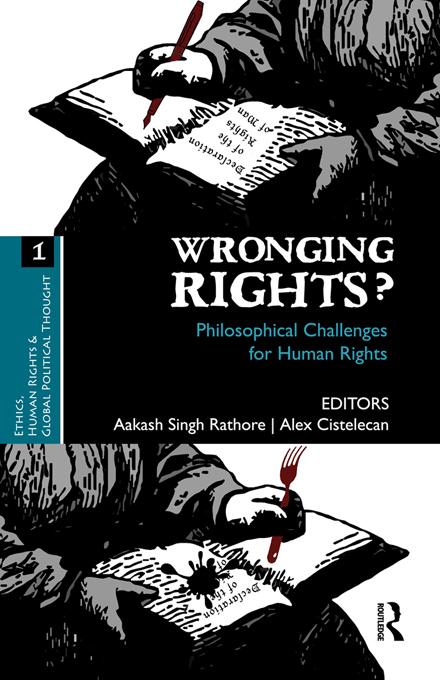
This book brings together two of the most powerful and relevant philosophical critiques of human rights: the post-colonialist and the post-Althusserian, its balanced internal structure not just throwing these two critiques together, but actually forcing them to enter into confrontation and dialogue.
The book is organised in three parts: at each end, the post-colonialist and the post-Althusserian critiques are represented by some of their main thinkers (Ratna Kapur, G. C. Spivak, Upendra Baxi; Slavoj Žižek, Jacques Rancière), while in the middle, an American intermezzo (Richard Rorty, Wendy Brown) functions as a genuine Derridian supplement: always already contaminating the purity of the two theoretical schools, preventing their enclosure and, hence, fuelling and complicating further their mutual confrontation. As in any authentic dialogue, the introduction and the conclusion each claim victory for one of the sides by changing the very terms and rules of the dialogue, picturing it as a confrontation between emancipatory universalism and inefficient particularism (from the perspective of the post-Althusserians), or as a split between hypocrisy and truth (from the perspective of the post-colonialists).
Payez facilement par carte, Klarna, Apple Pay ou Google Pay. Pas satisfait ? Vous avez toujours une garantie de remboursement de 14 jours. En savoir plus dans nos conditions. Si vous avez des questions, envoyez-nous un e-mail à hello@memmo.org.
Memmo facilite tes études, où que tu sois dans le monde. On rassemble tes manuels de cours et des outils d'étude intelligents au même endroit : résumés, quiz, podcasts et flashcards. Et il y a Ted, ton compagnon d'étude qui répond à toutes tes questions. Plus de 50 000 étudiants étudient déjà ici – conçu pour t'aider à apprendre plus vite et à moins stresser.