
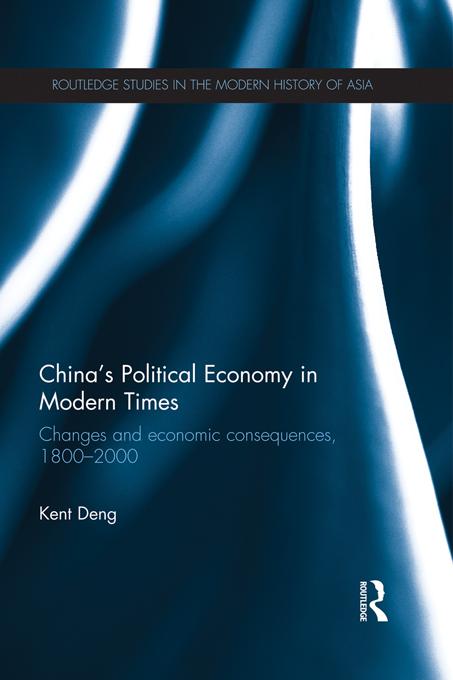
This book makes an important contribution to the study of changes in China’s institutions and their impact on the national economy as well as ordinary people’s daily material life from 1800 to 2000. Kent Deng reveals China’s mega-cycle of prosperity-poverty-prosperity without the usual attribution to the 1840 Opium War, or the alleged population pressure, class struggle and oriental despotism. The book challenges the conventional view on ‘rebellions’, ‘revolutions’ and their alleged motivations and outcomes. Its findings separate commonly circulated myth with reality based on solid evidence and careful evaluation. The benchmark used by the author is people’s entitlement and mundane day-to-day material well being, instead of the stereotype of aggregates of industrial hardware and national GDP.
China’s Political economy in Modern Times proves that state-building was the prime mover in China’s modern history. Contrary to the popular belief in mass movement, Deng shows convincingly that changes were in most cases imposed by a minority with external help. Therefore, the quality of the state was unpredictable, seen from the anti-state that cost lives and economic growth.
This book will be of interest to students and scholars of Chinese Politics, Chinese Economics, Chinese History, and Political Economy.
Payez facilement par carte, Klarna, Apple Pay ou Google Pay. Pas satisfait ? Vous avez toujours une garantie de remboursement de 14 jours. En savoir plus dans nos conditions. Si vous avez des questions, envoyez-nous un e-mail à hello@memmo.org.
Memmo facilite tes études, où que tu sois dans le monde. On rassemble tes manuels de cours et des outils d'étude intelligents au même endroit : résumés, quiz, podcasts et flashcards. Et il y a Ted, ton compagnon d'étude qui répond à toutes tes questions. Plus de 50 000 étudiants étudient déjà ici – conçu pour t'aider à apprendre plus vite et à moins stresser.