
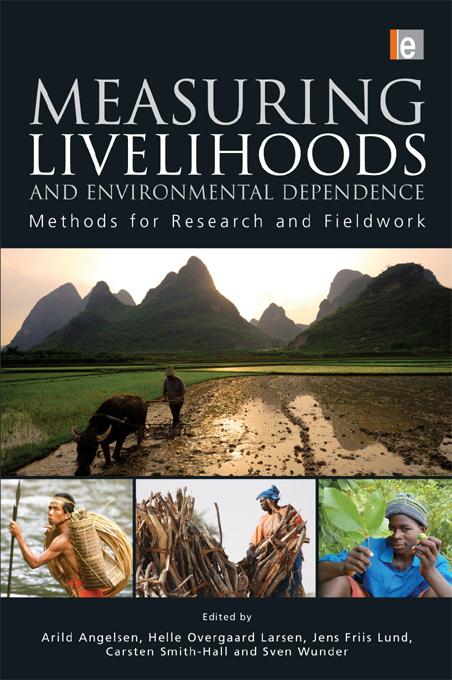
Thousands of surveys on rural livelihoods in developing countries are being done every year. Unfortunately, many suffer from weaknesses in methods and problems in implementation. Quantifying households' dependence on multiple environmental resources (forests, bush, grasslands and rivers) is particularly difficult and often simply ignored in the surveys. The results therefore do not reflect rural realities. In particular, 'the hidden harvest' from natural resources is generally too important to livelihoods for development research, policies and practice to ignore. Fieldwork using state-of-the-art methods, and in particular well-designed household questionnaires, thus becomes an imperative to adequately capture key dimensions of rural welfare.
This book describes how to do a better job when designing and implementing household and village surveys for quantitative assessment of rural livelihoods in developing countries. It covers the entire research process from planning to sharing research results. It draws on the experiences from a large global-comparative project, the Poverty Environment Network (PEN), to develop more robust and validated methods, enriched by numerous practical examples from the field. The book will provide an invaluable guide to methods and a practical handbook for students and professionals.
Payez facilement par carte, Klarna, Apple Pay ou Google Pay. Pas satisfait ? Vous avez toujours une garantie de remboursement de 14 jours. En savoir plus dans nos conditions. Si vous avez des questions, envoyez-nous un e-mail à hello@memmo.org.
Memmo facilite tes études, où que tu sois dans le monde. On rassemble tes manuels de cours et des outils d'étude intelligents au même endroit : résumés, quiz, podcasts et flashcards. Et il y a Ted, ton compagnon d'étude qui répond à toutes tes questions. Plus de 50 000 étudiants étudient déjà ici – conçu pour t'aider à apprendre plus vite et à moins stresser.