
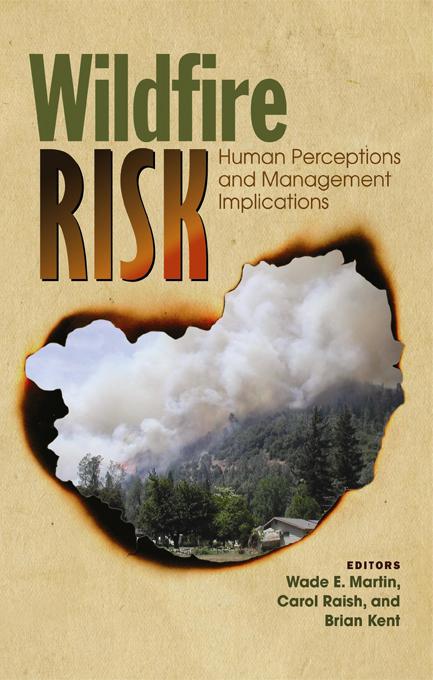
The continuing encroachment of human settlements into fire-prone areas and extreme fire seasons in recent years make it urgent that we better understand both the physical and human dimensions of managing the risk from wildfire. Wildfire Risk follows from our awareness that increasing public knowledge about wildfire hazard does not necessarily lead to appropriate risk reduction behavior. Drawing heavily upon health and risk communication, and risk modeling, the authors advance our understanding of how individuals and communities respond to wildfire hazard. They present results of original research on the social, economic, and psychological factors in responses to risk, discuss how outreach and education can influence behavior, and consider differences among ethnic/racial groups and between genders with regard to values, views, and attitudes about wildfire risk. They explore the role of public participation in risk assessment and mitigation, as well as in planning for evacuation and recovery after fire. Wildfire Risk concludes with a dedicated section on risk-modeling, with perspectives from decision sciences, geography, operations research, psychology, experimental economics, and other social sciences.
Payez facilement par carte, Klarna, Apple Pay ou Google Pay. Pas satisfait ? Vous avez toujours une garantie de remboursement de 14 jours. En savoir plus dans nos conditions. Si vous avez des questions, envoyez-nous un e-mail à hello@memmo.org.
Memmo facilite tes études, où que tu sois dans le monde. On rassemble tes manuels de cours et des outils d'étude intelligents au même endroit : résumés, quiz, podcasts et flashcards. Et il y a Ted, ton compagnon d'étude qui répond à toutes tes questions. Plus de 50 000 étudiants étudient déjà ici – conçu pour t'aider à apprendre plus vite et à moins stresser.
Tu pourrais aussi aimer
Acheter le livre0