
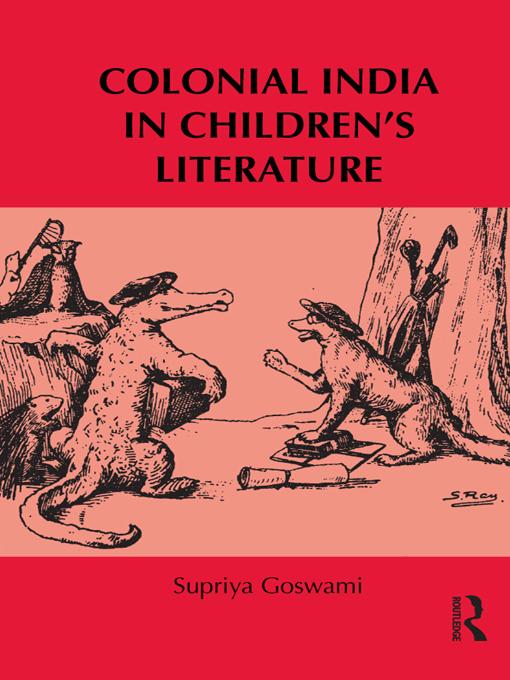
Colonial India in Children’s Literature is the first book-length study to explore the intersections of children’s literature and defining historical moments in colonial India. Engaging with important theoretical and critical literature that deals with colonialism, hegemony, and marginalization in children's literature, Goswami proposes that British, Anglo-Indian, and Bengali children’s literature respond to five key historical events: the missionary debates preceding the Charter Act of 1813, the defeat of Tipu Sultan, the Mutiny of 1857, the birth of Indian nationalism, and the Swadeshi movement resulting from the Partition of Bengal in 1905. Through a study of works by Mary Sherwood (1775-1851), Barbara Hofland (1770-1844), Sara Jeanette Duncan (1861-1922), Rudyard Kipling (1865-1936), Upendrakishore Ray (1863-1915), and Sukumar Ray (1887-1923), Goswami examines how children’s literature negotiates and represents these momentous historical forces that unsettled Britain’s imperial ambitions in India.
Goswami argues that nineteenth-century British and Anglo-Indian children’s texts reflect two distinct moods in Britain’s colonial enterprise in India. Sherwood and Hofland (writing before 1857) use the tropes of conversion and captivity as a means of awakening children to the dangers of India, whereas Duncan and Kipling shift the emphasis to martial prowess, adaptability, and empirical knowledge as defining qualities in British and Anglo-Indian children. Furthermore, Goswami’s analysis of early nineteenth-century children’s texts written by women authors redresses the preoccupation with male authors and boys’ adventure stories that have largely informed discussions of juvenility in the context of colonial India.
This groundbreaking book also seeks to open up the canon by examining early twentieth-century Bengali children’s texts that not only draw literary inspiration from nineteenth-century British children’s literature, but whose themes are equally shaped by empire.
Payez facilement par carte, Klarna, Apple Pay ou Google Pay. Pas satisfait ? Vous avez toujours une garantie de remboursement de 14 jours. En savoir plus dans nos conditions. Si vous avez des questions, envoyez-nous un e-mail à hello@memmo.org.
Memmo facilite tes études, où que tu sois dans le monde. On rassemble tes manuels de cours et des outils d'étude intelligents au même endroit : résumés, quiz, podcasts et flashcards. Et il y a Ted, ton compagnon d'étude qui répond à toutes tes questions. Plus de 50 000 étudiants étudient déjà ici – conçu pour t'aider à apprendre plus vite et à moins stresser.