
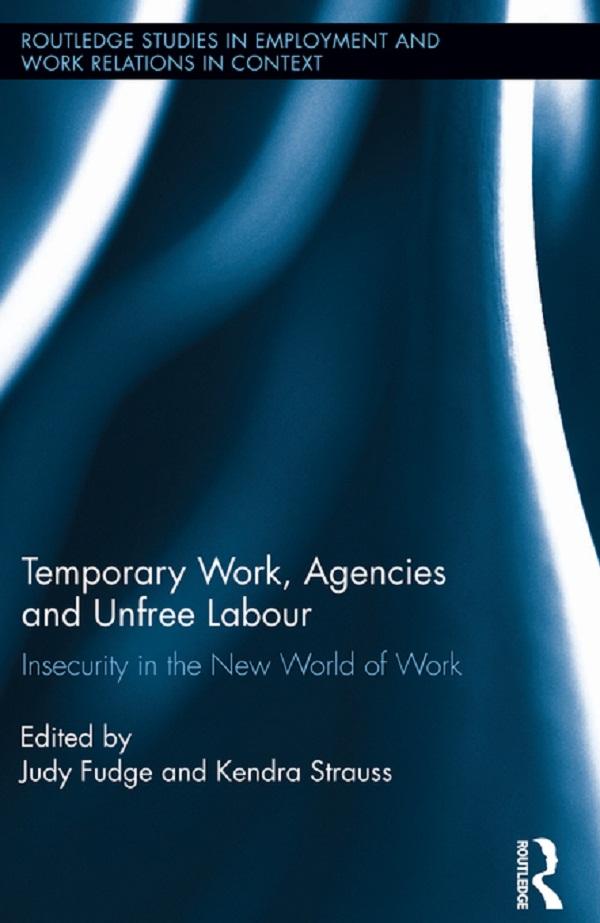
Unfree labor has not disappeared from advanced capitalist economies. In this sense the debates among and between Marxist and orthodox economic historians about the incompatibility of capitalism and unfree labor are moot: the International Labour Organisation has identified forced, coerced, and unfree labor as a contemporary issue of global concern. Previously hidden forms of unfree labor have emerged in parallel with several other well-documented trends affecting labor conditions, rights, and modes of regulation. These evolving types of unfree labor include the increasing normalization of contingent work (and, by extension, the undermining of the standard contract of employment), and an increase in labor intermediation. The normative, political, and numerical rise of temporary employment agencies in many countries in the last three decades is indicative of these trends.
It is in the context of this rapidly changing landscape that this book consolidates and expands on research designed to understand new institutions for work in the global era. This edited collection provides a theoretical and empirical exploration of the links between unfree labor, intermediation, and modes of regulation, with particular focus on the evolving institutional forms and political-economic contexts that have been implicated in, and shaped by, the ascendency of temp agencies. What is distinctive about this collection is this bi-focal lens: it makes a substantial theoretical contribution by linking disparate literatures on, and debates about, the co-evolution of contingent work and unfree labor, new forms of labor intermediation, and different regulatory approaches; but it further lays the foundation for this theory in a series of empirically rich and geographically diverse case studies. This integrative approach is grounded in a cross-national comparative framework, using this approach as the basis for assessing how, and to what extent, temporary agency work can be considered unfree wage labor
Payez facilement par carte, Klarna, Apple Pay ou Google Pay. Pas satisfait ? Vous avez toujours une garantie de remboursement de 14 jours. En savoir plus dans nos conditions. Si vous avez des questions, envoyez-nous un e-mail à hello@memmo.org.
Memmo facilite tes études, où que tu sois dans le monde. On rassemble tes manuels de cours et des outils d'étude intelligents au même endroit : résumés, quiz, podcasts et flashcards. Et il y a Ted, ton compagnon d'étude qui répond à toutes tes questions. Plus de 50 000 étudiants étudient déjà ici – conçu pour t'aider à apprendre plus vite et à moins stresser.