
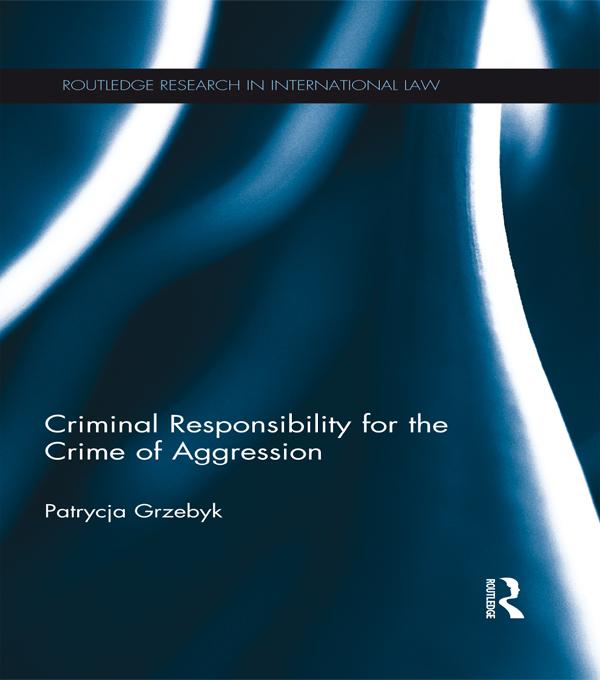
Since the Nuremberg trial, the crime of aggression has been considered one of the gravest international crimes. However, since the 1940s no defendants have been charged with this crime, with some states actively opposing the notion of punishing aggression. The option of trying an individual for aggression is expressly included in the statute of the International Criminal Court. In 2010 the Assembly of States Parties adopted a definition of the crime of aggression and conditions of the exercise of jurisdiction over this crime by the Court. The Assembly also agreed that the decision on including the crime of aggression within the Court’s jurisdiction would be made in 2017 at the earliest. It is still internationally debatable whether the criminalisation of aggression is an outcome to strive for, or whether its abandonment is more preferable.
In Criminal Responsibility for the Crime of Aggression, Patrycja Grzebyk explores the scope of criminal responsibility of individuals for crimes of aggression and asks why those responsible for aggression are not brought to justice. The book first works to identify the legal norms that define and delegalise aggression, before moving to determine the basis and scope for the criminalisation of aggression. The book then goes on to identify the key risks and difficulties inherent in trials for aggression.
Following a string of awards in Poland, including the Manfred Lachs Prize for the best first book on public international law, this cutting investigation of aggression is now deservedly made available to the wider world. In its extensive analysis of international trials on aggression, and its synthesis of legal, political and historical rhetoric, this book offers broad and striking insight into the criminal responsibility of individuals on a world stage.
Payez facilement par carte, Klarna, Apple Pay ou Google Pay. Pas satisfait ? Vous avez toujours une garantie de remboursement de 14 jours. En savoir plus dans nos conditions. Si vous avez des questions, envoyez-nous un e-mail à hello@memmo.org.
Memmo facilite tes études, où que tu sois dans le monde. On rassemble tes manuels de cours et des outils d'étude intelligents au même endroit : résumés, quiz, podcasts et flashcards. Et il y a Ted, ton compagnon d'étude qui répond à toutes tes questions. Plus de 50 000 étudiants étudient déjà ici – conçu pour t'aider à apprendre plus vite et à moins stresser.