
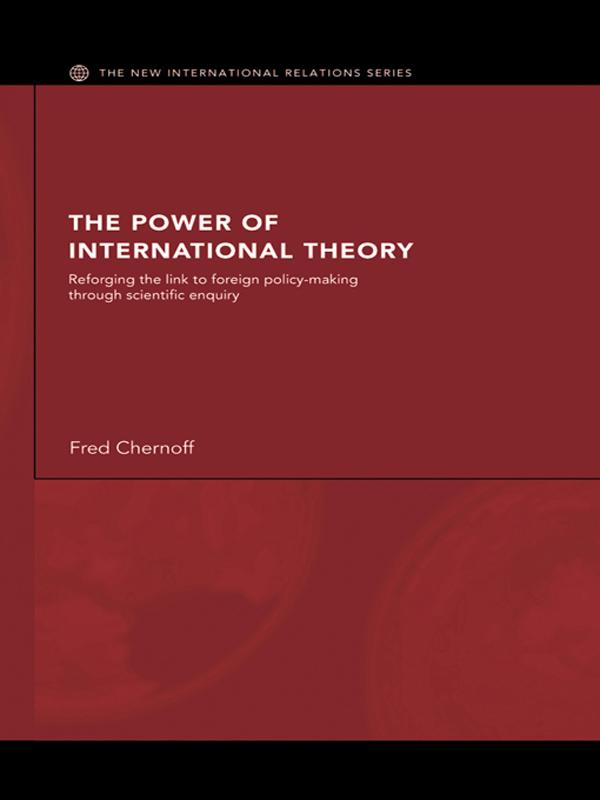
This new study challenges how we think about international relations, presenting an analysis of current trends and insights into new directions.
It shows how the discipline of international relations was created with a purpose of helping policy-makers to build a more peaceful and just world. However, many of the current trends, post-positivism, constructivism, reflectivism, and post-modernism share a conception of international theory that is inherently incapable of offering significant guidance to policy-makers.
The Power of International Theory critically examines these approaches and offers a novel conventional-causal alternative that allows the reforging of a link between IR theory and policy-making. While recognizing the criticisms of earlier forms of positivism and behaviouralism, the book defends holistic testing of empirical principles, methodological pluralism, criteria for choosing the best theory, a notion of 'causality,' and a limited form of prediction, all of which are needed to guide policy-makers.
This is an essential book for all students and scholars of international relations.
Payez facilement par carte, Klarna, Apple Pay ou Google Pay. Pas satisfait ? Vous avez toujours une garantie de remboursement de 14 jours. En savoir plus dans nos conditions. Si vous avez des questions, envoyez-nous un e-mail à hello@memmo.org.
Memmo facilite tes études, où que tu sois dans le monde. On rassemble tes manuels de cours et des outils d'étude intelligents au même endroit : résumés, quiz, podcasts et flashcards. Et il y a Ted, ton compagnon d'étude qui répond à toutes tes questions. Plus de 50 000 étudiants étudient déjà ici – conçu pour t'aider à apprendre plus vite et à moins stresser.