
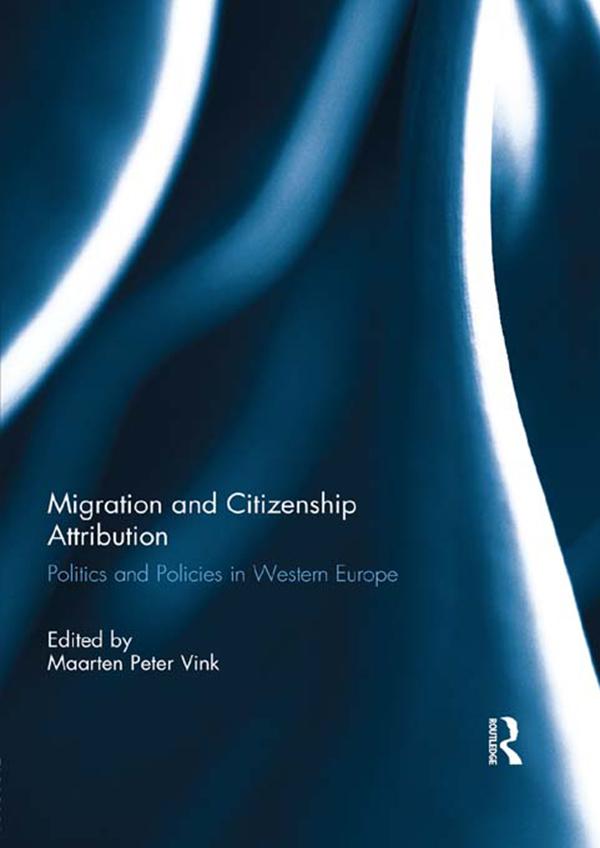
How do states in Western Europe deal with the challenges of migration for citizenship? The legal relationship between a person and a state is becoming increasingly blurred in our mobile, transnational world. This volume deals with the membership dimension of citizenship, specifically the formal rules that states use to attribute citizenship. These nationally-specific rules determine how and under what conditions citizenship is attributed by states to individuals: how one can acquire formal citizenship status, but also how this status can be lost.
Migration and Citizenship Attribution observes various trends in citizenship policies since the early 1980s, analysing historical patterns and recent changes across Western Europe as well as examining specific developments in individual countries. Authors explore the equal treatment of women and men with regard to descent-based citizenship attribution, along with the process of convergence between countries with ‘ius soli’ and ‘ius sanguinis’ traditions with regard to birthright provisions. They consider how the increasing acceptance of multiple citizenship is reflected in a dual trend to abolish, or at least to moderate, the renunciation of the citizenship of origin as a condition for naturalisation, and also to restrict provisions of loss of citizenship due to voluntary acquisition of a foreign citizenship. Another trend observed and discussed is the introduction by many countries of language tests and integration conditions in the naturalisation procedure, with some countries now concluding the naturalisation process by means of a US-styled citizenship ceremony. Contributors also explore the various things taken into account under state citizenship laws such as statelessness, or membership of the European Union.
This book was originally published as a special issue of the Journal of Ethnic and Migration Studies.
Payez facilement par carte, Klarna, Apple Pay ou Google Pay. Pas satisfait ? Vous avez toujours une garantie de remboursement de 14 jours. En savoir plus dans nos conditions. Si vous avez des questions, envoyez-nous un e-mail à hello@memmo.org.
Memmo facilite tes études, où que tu sois dans le monde. On rassemble tes manuels de cours et des outils d'étude intelligents au même endroit : résumés, quiz, podcasts et flashcards. Et il y a Ted, ton compagnon d'étude qui répond à toutes tes questions. Plus de 50 000 étudiants étudient déjà ici – conçu pour t'aider à apprendre plus vite et à moins stresser.