
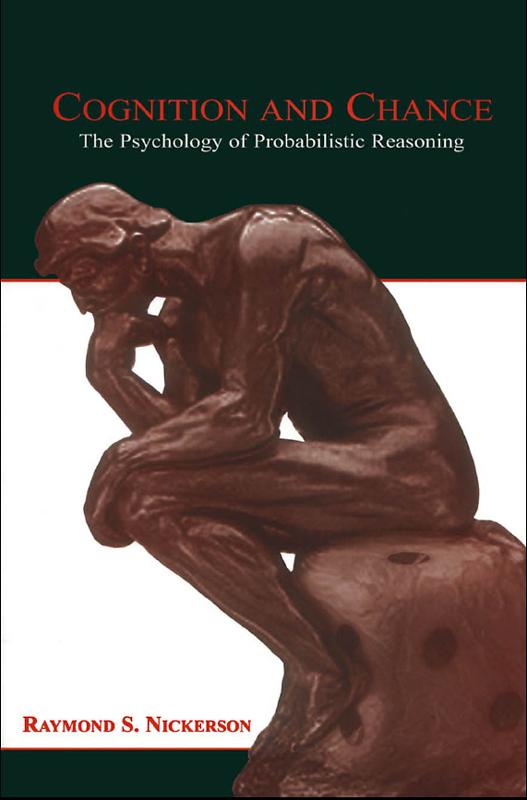
Lack of ability to think probabilistically makes one prone to a variety of irrational fears and vulnerable to scams designed to exploit probabilistic naiveté, impairs decision making under uncertainty, facilitates the misinterpretation of statistical information, and precludes critical evaluation of likelihood claims. Cognition and Chance presents an overview of the information needed to avoid such pitfalls and to assess and respond to probabilistic situations in a rational way. Dr. Nickerson investigates such questions as how good individuals are at thinking probabilistically and how consistent their reasoning under uncertainty is with principles of mathematical statistics and probability theory. He reviews evidence that has been produced in researchers' attempts to investigate these and similar types of questions. Seven conceptual chapters address such topics as probability, chance, randomness, coincidences, inverse probability, paradoxes, dilemmas, and statistics. The remaining five chapters focus on empirical studies of individuals' abilities and limitations as probabilistic thinkers. Topics include estimation and prediction, perception of covariation, choice under uncertainty, and people as intuitive probabilists.
Cognition and Chance is intended to appeal to researchers and students in the areas of probability, statistics, psychology, business, economics, decision theory, and social dilemmas.
Payez facilement par carte, Klarna, Apple Pay ou Google Pay. Pas satisfait ? Vous avez toujours une garantie de remboursement de 14 jours. En savoir plus dans nos conditions. Si vous avez des questions, envoyez-nous un e-mail à hello@memmo.org.
Memmo facilite tes études, où que tu sois dans le monde. On rassemble tes manuels de cours et des outils d'étude intelligents au même endroit : résumés, quiz, podcasts et flashcards. Et il y a Ted, ton compagnon d'étude qui répond à toutes tes questions. Plus de 50 000 étudiants étudient déjà ici – conçu pour t'aider à apprendre plus vite et à moins stresser.