
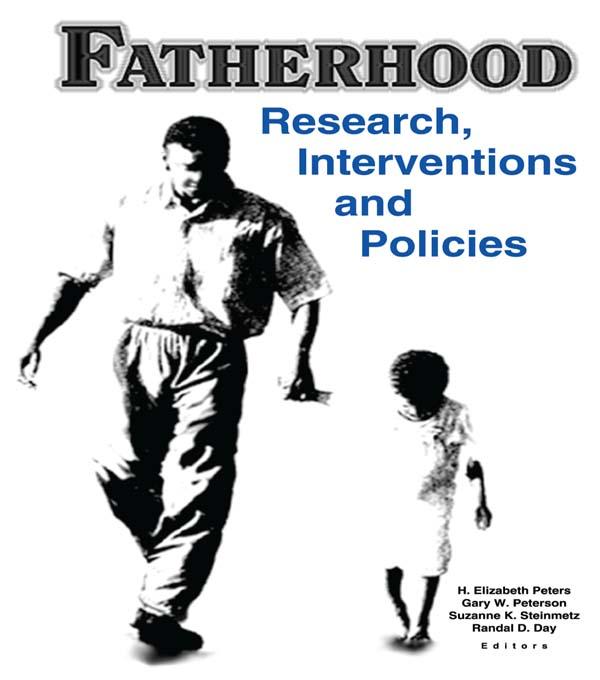
How much power does a father have to influence his children's development? A lively and often heated public debate on the role and value of the father in a family has been underway in the United States for the past decade. Nevertheless, we are far from understanding the complex ways in which fathers make contributions to their families and children. Fatherhood: Research, Interventions, and Policies addresses the central questions of the role of fathers: What is the impact of father involvement on child outcomes? What factors predict increased involvement of fathers?Bringing together papers presented at the Conference on Father Involvement, this volume includes contributions by leading scholars in anthropology, demography, economics, family science, psychology, and sociology. Many of the contributors also address the implications of father involvement for family policy issues, including family leave, child care, and child support. Furthermore, the discussion of fatherhood ranges well beyond the case of intact, middle-class, white families to include fathers from various ethnic groups and socioeconomic classes and of varied marital status, including fathers of nonmarital children, single-father families, and nonresident fathers. Fatherhood: Research, Interventions, and Policies addresses both practical and theoretical concerns, including:
- the redefinition of fatherhood
- changes over time in research on fatherhood
- the predictive power of fathers’activities on their children's adult outcomes
- the correlation between fathers’income and their involvement with their nonmarital children
- the influence of fathers on their sons’probability of growing up to become responsible fathers
- the effects of divorce on father-son and father-daughter relationships
- interventions that help to keep divorced fathers in touch with their childrenThis comprehensive, powerful book combines pioneering empirical research with thoughtful consideration of the social and psychological implications of fatherhood. It is essential reading for researchers, policymakers, psychologists, and students of family studies, human development, gender studies, social policy, sociology, and human ecology.
Payez facilement par carte, Klarna, Apple Pay ou Google Pay. Pas satisfait ? Vous avez toujours une garantie de remboursement de 14 jours. En savoir plus dans nos conditions. Si vous avez des questions, envoyez-nous un e-mail à hello@memmo.org.
Memmo facilite tes études, où que tu sois dans le monde. On rassemble tes manuels de cours et des outils d'étude intelligents au même endroit : résumés, quiz, podcasts et flashcards. Et il y a Ted, ton compagnon d'étude qui répond à toutes tes questions. Plus de 50 000 étudiants étudient déjà ici – conçu pour t'aider à apprendre plus vite et à moins stresser.