
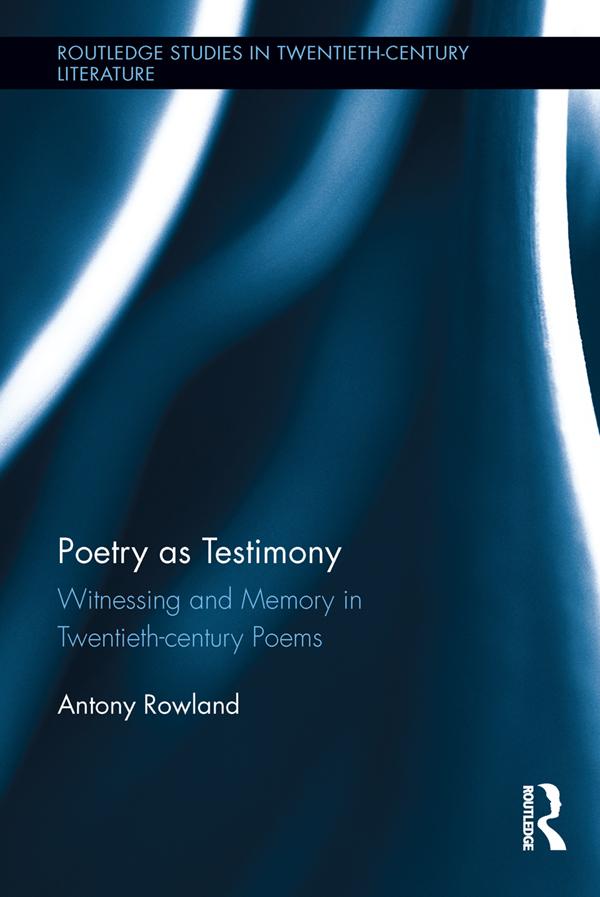
This book analyzes Holocaust poetry, war poetry, working-class poetry, and 9/11 poetry as forms of testimony. Rowland argues that testamentary poetry requires a different approach to traditional ways of dealing with poems due to the pressure of the metatext (the original, traumatic events), the poems’ demands for the hyper-attentiveness of the reader, and a paradox of identification that often draws the reader towards identifying with the poet’s experience, but then reminds them of its sublimity. He engages with the work of a diverse range of twentieth-century authors and across the literature of several countries, even uncovering new archival material. The study ends with an analysis of the poetry of 9/11, engaging with the idea that it typifies a new era of testimony where global, secondary witnesses react to a proliferation of media images. This book ranges across the literature of several countries, cultures, and historical events in order to stress the large variety of contexts in which poetry has functioned productively as a form of testimony, and to note the importance of the availability of translations to the formation of literary canons.
Payez facilement par carte, Klarna, Apple Pay ou Google Pay. Pas satisfait ? Vous avez toujours une garantie de remboursement de 14 jours. En savoir plus dans nos conditions. Si vous avez des questions, envoyez-nous un e-mail à hello@memmo.org.
Memmo facilite tes études, où que tu sois dans le monde. On rassemble tes manuels de cours et des outils d'étude intelligents au même endroit : résumés, quiz, podcasts et flashcards. Et il y a Ted, ton compagnon d'étude qui répond à toutes tes questions. Plus de 50 000 étudiants étudient déjà ici – conçu pour t'aider à apprendre plus vite et à moins stresser.