
“An indispensable reference for all researchers interested in the measurement of social welfare. . .”
—François Bourguignon, Emeritus Professor at Paris School of Economics, Former Chief Economist of the World Bank.
“. . .a detailed, insightful, and pedagogical presentation of the theoretical grounds of multidimensional well-being, inequality, and poverty measurement. Any student, researcher, and practitioner interested in the multidimensional approach should begin their journey into such a fascinating theme with this wonderful book.”
—François Maniquet, Professor, Catholic University of Louvain, Belgium.
A Review of the Multidimensional Approaches to the Measurement of Welfare, Inequality, and Poverty
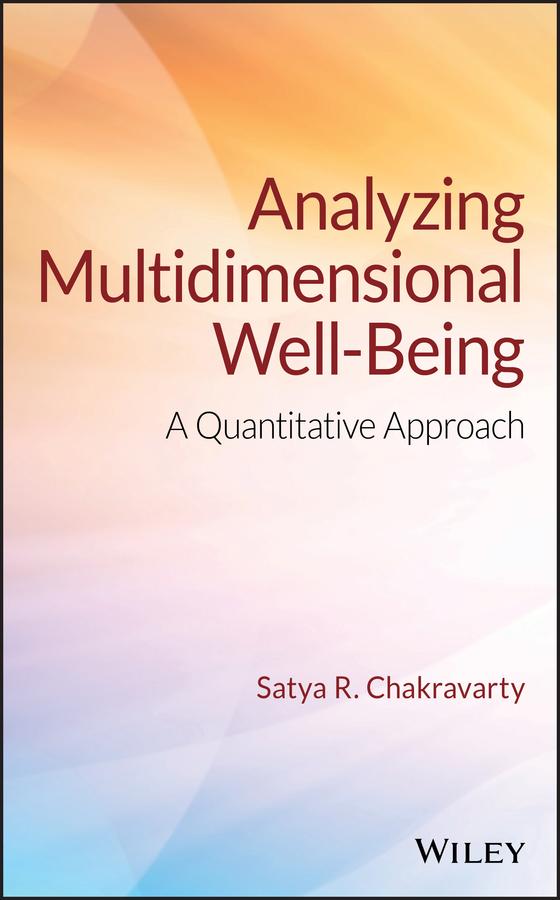
Analyzing Multidimensional Well-Being: A Quantitative Approach offers a comprehensive approach to the measurement of well-being that includes characteristics such as income, health, literacy, and housing. The author presents a systematic comparison of the alternative approaches to the measurement of multidimensional welfare, inequality, poverty, and vulnerability. The text contains real-life applications of some multidimensional aggregations (most of which have been designed by international organizations such as the United Nations
Development Program and the Organization for Economic Co-operation and Development) that help to judge the performance of a country in the various dimensions of well-being.
The text offers an evaluation of how well a society is doing with respect to achievements of all the individuals in the dimensions considered and clearly investigates how achievements in the dimensions can be evaluated from different perspectives. The author includes a detailed scrutiny of alternative techniques for setting weights to individual dimensional metrics and offers an extensive analysis into both the descriptive and welfare theoretical approaches to the concerned multi-attribute measurement and related issues. This important resource:
• Contains a synthesis of multidimensional welfare, inequality, poverty, and vulnerability analysis
• Examines aggregations of achievement levels in the concerned dimensions of well-being from various standpoints
• Shows how to measure poverty using panel data instead of restricting attention to a single period and when we have imprecise information on dimensional achievements
• Argues that multidimensional analysis is intrinsically different from marginal distributions-based analysis
Written for students, teachers, researchers, and scholars, Analyzing Multidimensional Well-Being: A Quantitative Approach puts the focus on various approaches to the measurementof the many aspects of well-being and quality of life.
Satya R. Chakravarty is a Professor of Economics at the Indian Statistical Institute, Kolkata, India. He is an Editor of Social Choice and Welfare and a member of the Editorial Board of Journal of Economic Inequality.
Payez facilement par carte, Klarna, Apple Pay ou Google Pay. Pas satisfait ? Vous avez toujours une garantie de remboursement de 14 jours. En savoir plus dans nos conditions. Si vous avez des questions, envoyez-nous un e-mail à hello@memmo.org.
Memmo facilite tes études, où que tu sois dans le monde. On rassemble tes manuels de cours et des outils d'étude intelligents au même endroit : résumés, quiz, podcasts et flashcards. Et il y a Ted, ton compagnon d'étude qui répond à toutes tes questions. Plus de 50 000 étudiants étudient déjà ici – conçu pour t'aider à apprendre plus vite et à moins stresser.