
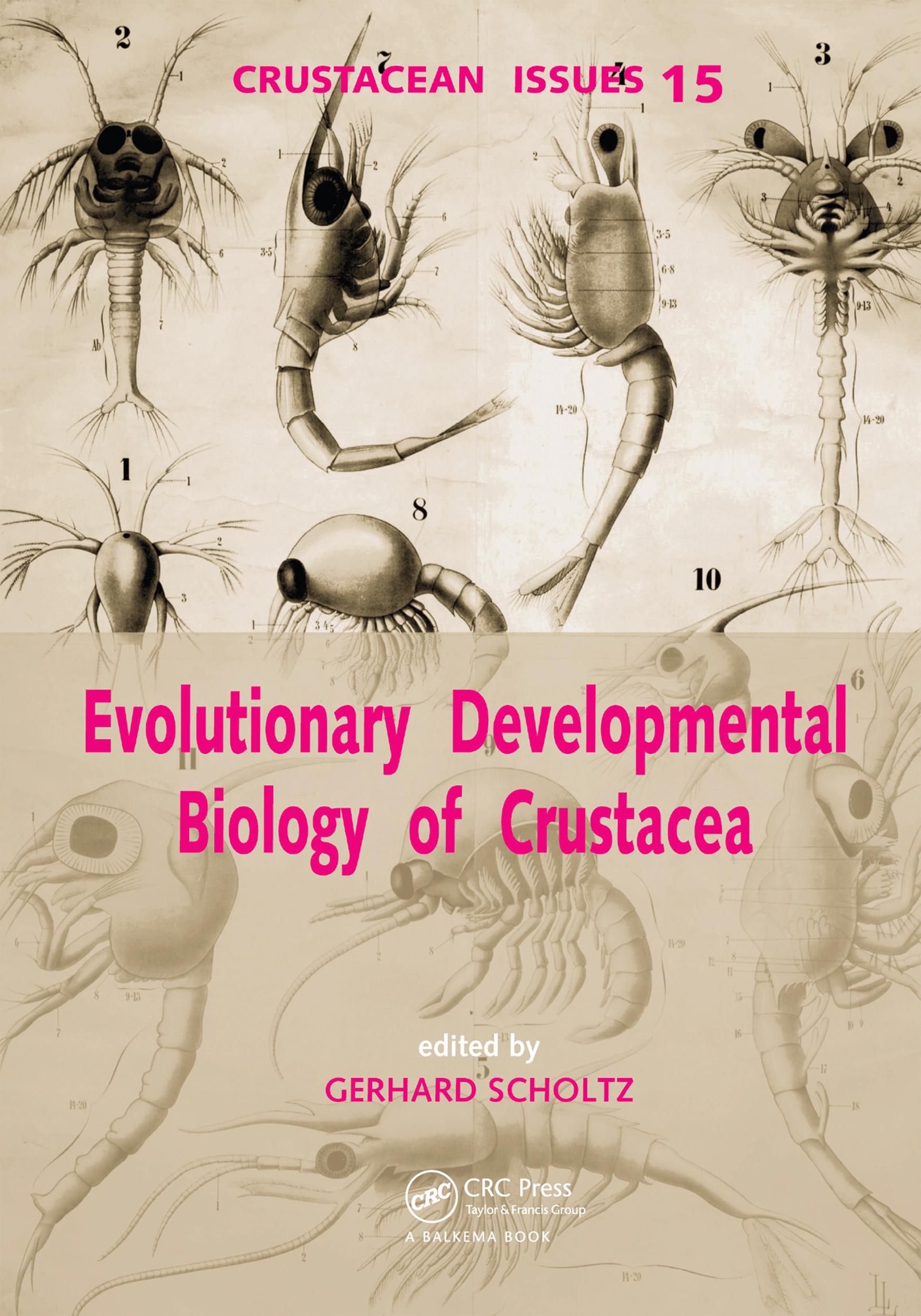
Crustaceans, due to the great diversity of their body organization, segmentation patterns, tagmatization, limb types, larval forms, cleavage, and gastrulation modes, are highly desirable for the study of questions at the interface of evolution and development. Modern interest in evolutionary developmental biology (evo-devo) rests on the molecular genetic approach and a variety of molecular techniques have proven fruitful when performed on crustaceans.
Evolutionary Developmental Biology of Crustacea presents a comprehensive treatment of all aspects of the field, beginning with a discussion of the implications of the typological Bauplan and phylum concepts versus historical concepts such as ground pattern and monophylum for the formulation of conceptual questions in evo-devo. Following this, the authors present the results of Hox gene expression in various crustacean taxa, aspects of segment formation at the cellular and genetic levels, the formation of segmental structures such as neurons, ganglia, and limbs, and the role of morphological ontogenetic characters in resolving phylogenetic relationships.
By covering so many general aspects of crustacean development, morphology, and evolution, Evolutionary Developmental Biology of Crustacea serves as an indispensable reference for developmental and evolutionary biologists investigating the role of genetics in evolution and development.
Payez facilement par carte, Klarna, Apple Pay ou Google Pay. Pas satisfait ? Vous avez toujours une garantie de remboursement de 14 jours. En savoir plus dans nos conditions. Si vous avez des questions, envoyez-nous un e-mail à hello@memmo.org.
Memmo facilite tes études, où que tu sois dans le monde. On rassemble tes manuels de cours et des outils d'étude intelligents au même endroit : résumés, quiz, podcasts et flashcards. Et il y a Ted, ton compagnon d'étude qui répond à toutes tes questions. Plus de 50 000 étudiants étudient déjà ici – conçu pour t'aider à apprendre plus vite et à moins stresser.