
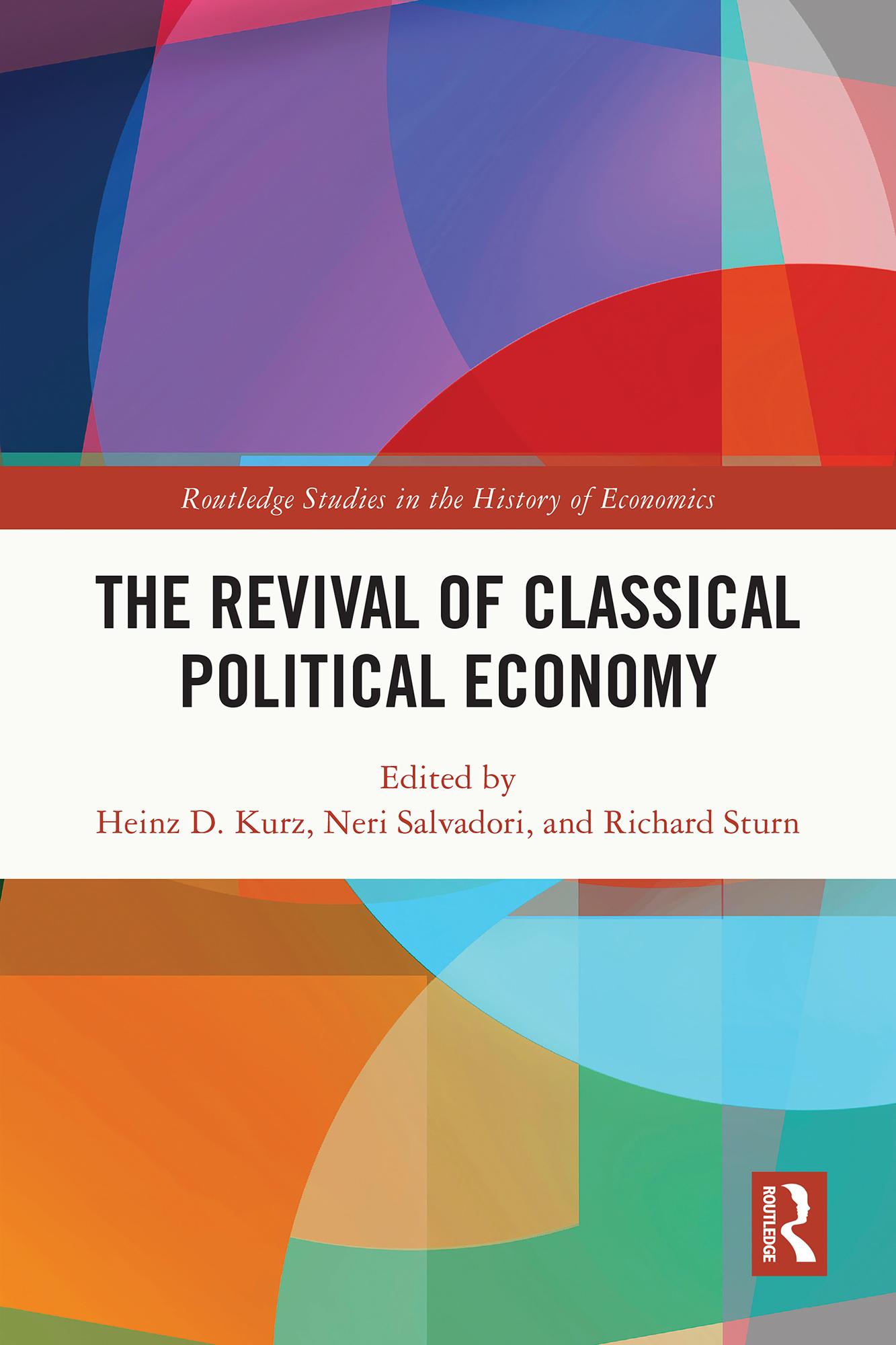
Recent years have seen renewed interest in classical political economy. The essays in this collection, presented in honour of Christian Gehrke, explore the central tenets of classical political economy, its comeback in the aftermath of Sraffa’s works and the engagement of major economists.
The chapters in the opening section present a gradual elaboration of what became known as the “classical” approach to political economy, with the theory of value and distribution as its core piece. It concerns what Sraffa called the “standpoint” of the classical economist, which revolves around the concept of “social surplus”, its distribution mainly as property incomes, and how “physical real costs” together with income distribution governs relative prices in conditions of free competition. The classical authors dealt with include François Quesnay, Richard Cantillon, David Hume, Adam Smith and especially David Ricardo. The second section explores the resurgence of classical political economy. Major elements of this comeback were, first, a new interpretation of the role of the labour theory of value, which especially Ricardo had adopted as a makeshift solution in the absence of a coherent theory of value; and, secondly, the demonstration that relative competitive prices and the general rate of profits can be ascertained in terms of the givens in the classical approach to value and distribution. The implication of the findings within a classical framework of the analysis for marginalist theory are drawn. Finally, there are contributions dealing with the works of major economists, who at different times and in various contexts interacted with and intervened in the debates alluded to or tackled entirely novel problems. This applies especially to the problem of cyclical economic development or business cycles, which was particularly addressed by economists such as Otto Bauer, Friedrich August Hayek, and Joseph A. Schumpeter.
The book will be of great interest to readers in political economy, history of economic thought and economic theory.
Payez facilement par carte, Klarna, Apple Pay ou Google Pay. Pas satisfait ? Vous avez toujours une garantie de remboursement de 14 jours. En savoir plus dans nos conditions. Si vous avez des questions, envoyez-nous un e-mail à hello@memmo.org.
Memmo facilite tes études, où que tu sois dans le monde. On rassemble tes manuels de cours et des outils d'étude intelligents au même endroit : résumés, quiz, podcasts et flashcards. Et il y a Ted, ton compagnon d'étude qui répond à toutes tes questions. Plus de 50 000 étudiants étudient déjà ici – conçu pour t'aider à apprendre plus vite et à moins stresser.