
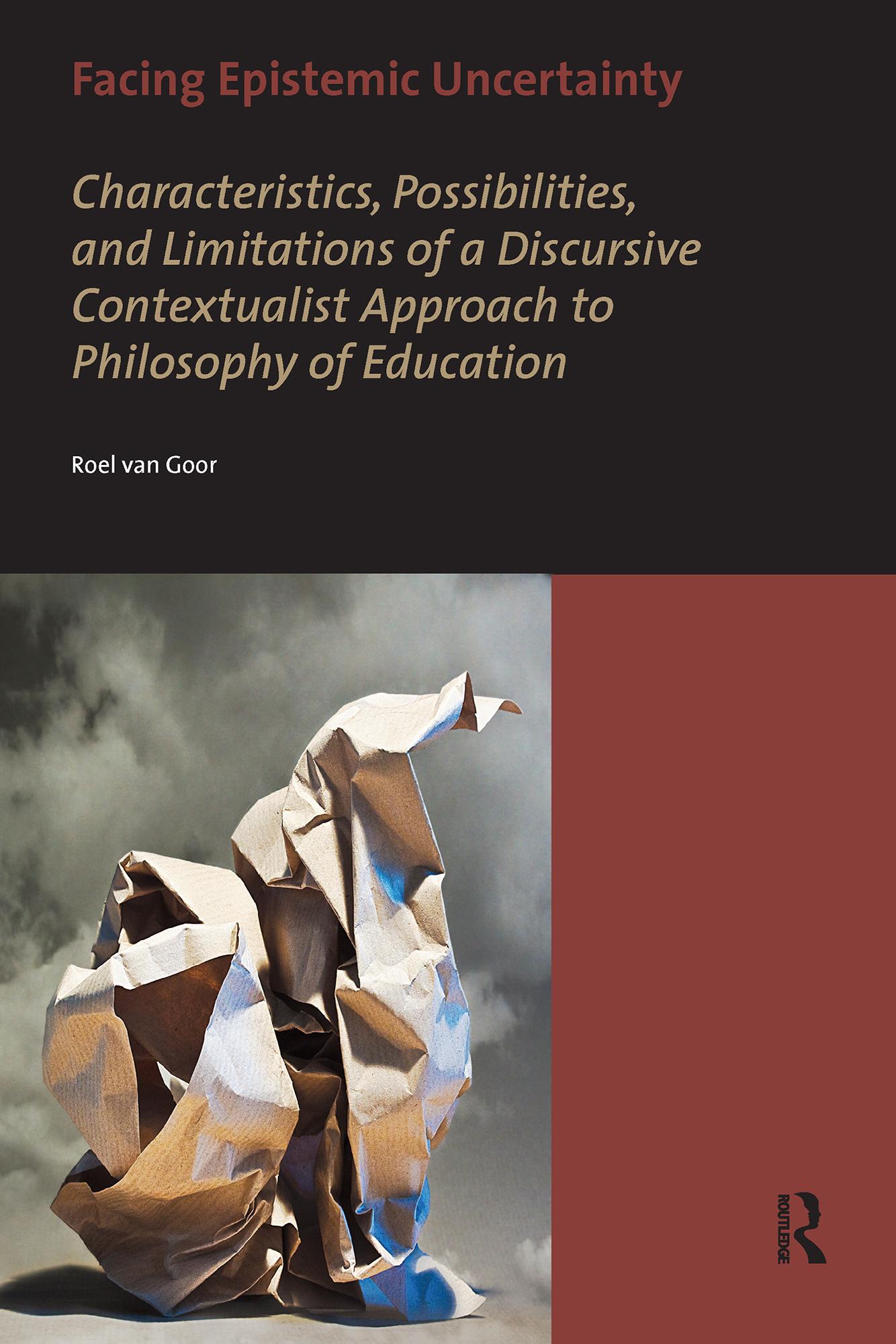
Increasing doubts over the narratives that traditionally served to legitimize the tasks and possibilities of societal institutions – such as science – have also called into question the significance of philosophy to educational thinking. Related debates largely concern epistemological issues, i.e. issues regarding the nature and status of (scientific) knowledge. This dissertation takes as its starting point the nowadays hardly controversial idea that all knowledge is to a certain extent ‘uncertain’. The questions addressed are how this ‘epistemic uncertainty’may be intelligibly understood, and what consequences can be drawn from such an understanding for the tasks and possibilities of philosophy of education as an academic discipline. In response to antifoundationalist as well as fallibilist authors, the author develops a discursive contextualist approach to epistemology that gives way to a philosophy of education that has both critical-reflective and theoretical-constructive potential, as is illustrated in relation to the educational issue of dealing with ‘students at risk’.
Payez facilement par carte, Klarna, Apple Pay ou Google Pay. Pas satisfait ? Vous avez toujours une garantie de remboursement de 14 jours. En savoir plus dans nos conditions. Si vous avez des questions, envoyez-nous un e-mail à hello@memmo.org.
Memmo facilite tes études, où que tu sois dans le monde. On rassemble tes manuels de cours et des outils d'étude intelligents au même endroit : résumés, quiz, podcasts et flashcards. Et il y a Ted, ton compagnon d'étude qui répond à toutes tes questions. Plus de 50 000 étudiants étudient déjà ici – conçu pour t'aider à apprendre plus vite et à moins stresser.
Tu pourrais aussi aimer
Acheter le livre0