
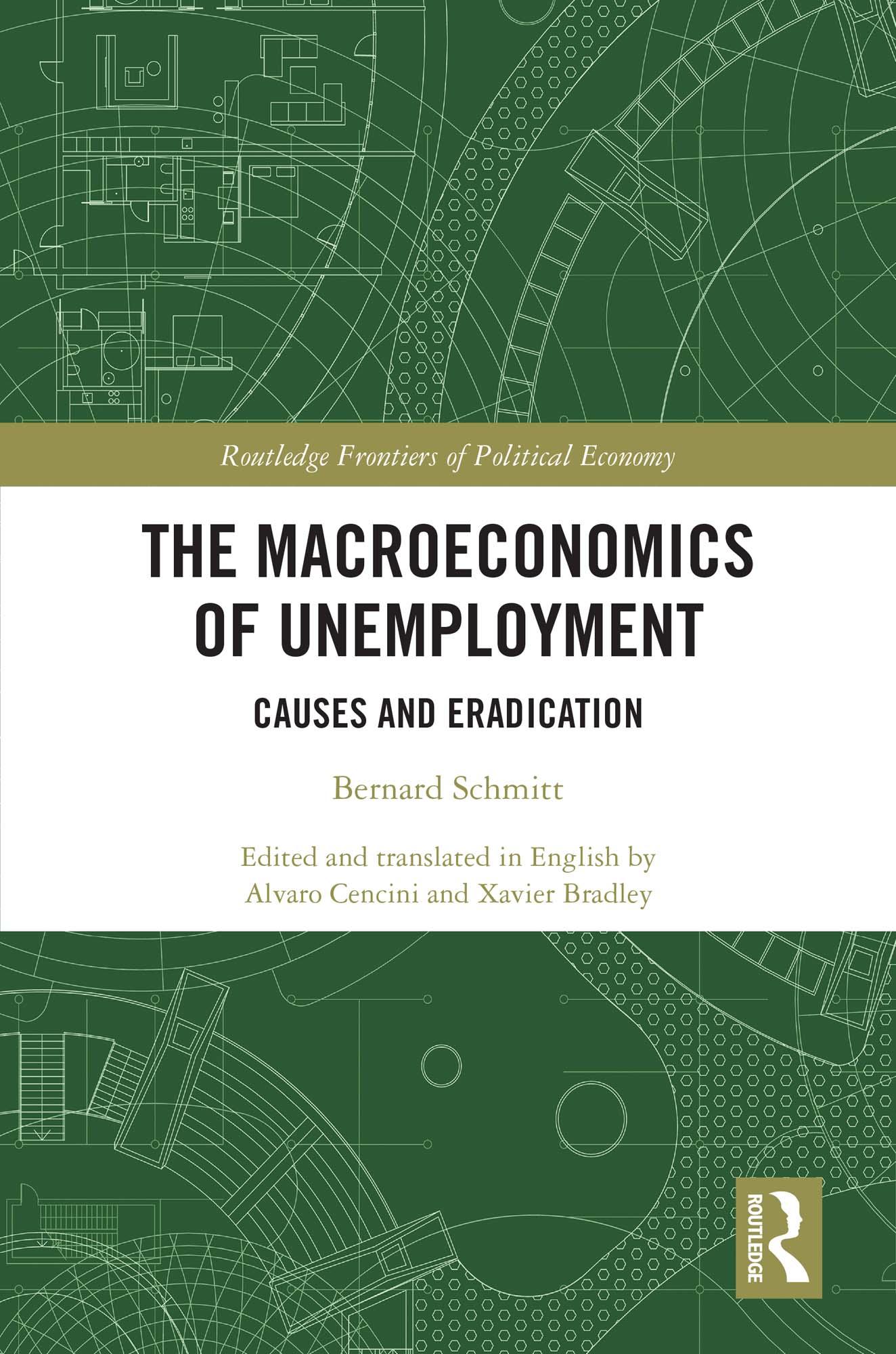
This book explores unemployment from a monetary macroeconomics perspective, identifying the pathology at the origin of unemployment and the principles of reform that will enable a passage from capitalism to post‑capitalism.
Bernard Schmitt explores the problem of involuntary unemployment by developing his quantum monetary macroeconomic analysis, demonstrating that the presence of fixed capital increases both physical productivity and the production of economic value. Money is at the core of Schmitt’s analysis because the relation between money and output is what makes it difficult to explain the origin of involuntary unemployment. Schmitt shows that unemployment is formally impossible in any economy producing wage‑, interest‑, and investment‑goods. It is only when the economic system includes fixed capital amortization that the conditions for the formation of unemployment are met. The determining role is played by the natural rate of interest: when this rate falls below the market rate of interest, unemployment sets in. Schmitt provides a new explanation of the mechanism leading to unemployment and advocates a reform that, if implemented, would break any link between capital accumulation and unemployment.
This book is essential reading for those interested in issues around unemployment and post‑capitalism as well as the fields of political economy, macroeconomics, economic theory, and heterodox economics more broadly.
Payez facilement par carte, Klarna, Apple Pay ou Google Pay. Pas satisfait ? Vous avez toujours une garantie de remboursement de 14 jours. En savoir plus dans nos conditions. Si vous avez des questions, envoyez-nous un e-mail à hello@memmo.org.
Memmo facilite tes études, où que tu sois dans le monde. On rassemble tes manuels de cours et des outils d'étude intelligents au même endroit : résumés, quiz, podcasts et flashcards. Et il y a Ted, ton compagnon d'étude qui répond à toutes tes questions. Plus de 50 000 étudiants étudient déjà ici – conçu pour t'aider à apprendre plus vite et à moins stresser.