
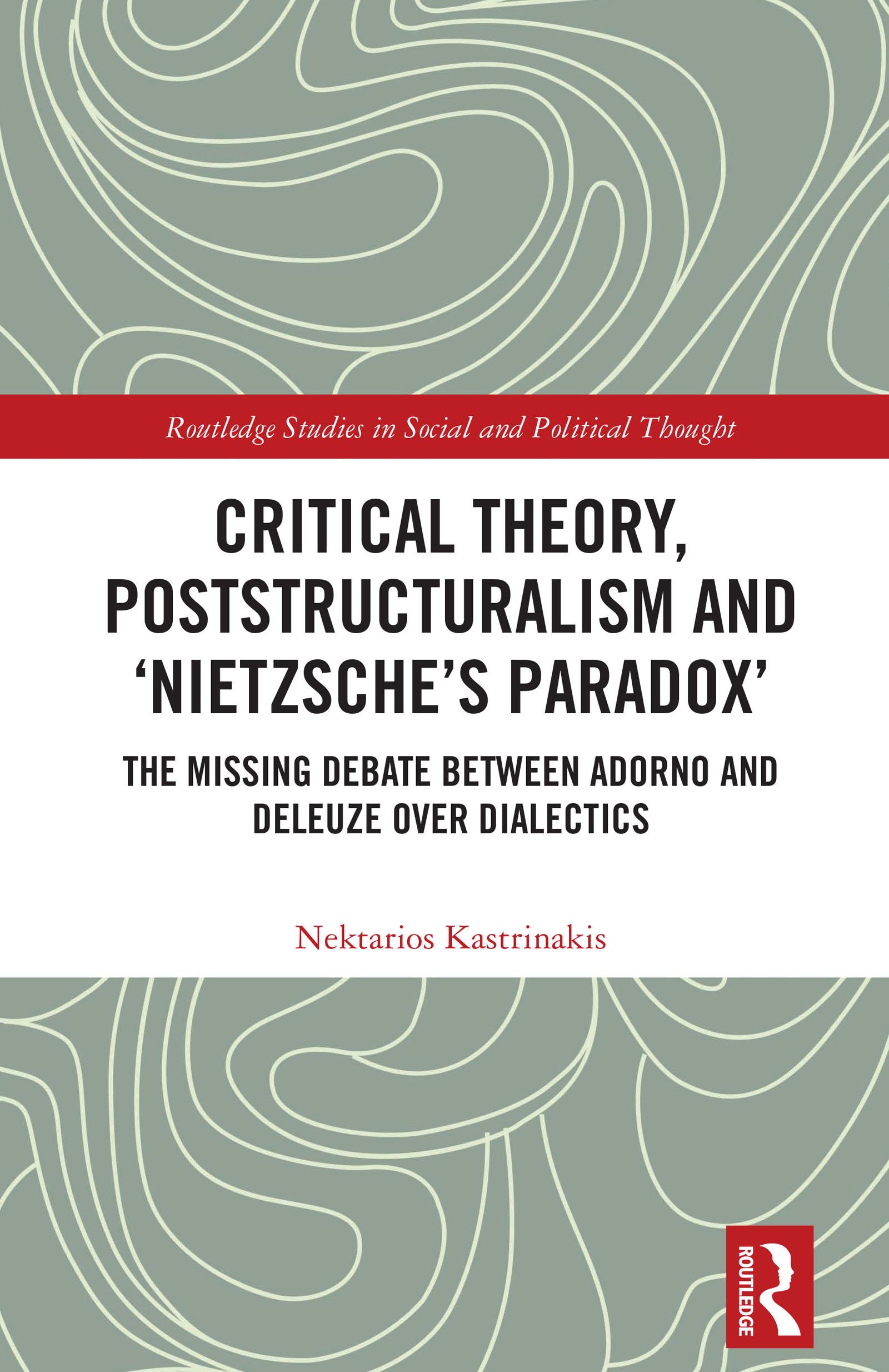
Critical Theory, Poststructuralism and ‘Nietzsche’s Paradox’ addresses a fundamental question in the exchange between Critical Theory and poststructuralism: is poststructuralism justified in its critique of dialectical thinking and in the conclusion of this critique that we need to leave dialectics behind us to properly understand the social world?
When Deleuze’s book Nietzsche and Philosophy was first published back in 1962, it caused a sensation in France, and its Nietzschean critique of Hegelian dialectics played a pivotal role in the emergence of the current of thought we call poststructuralism. However, to what extent is this critique valid and justified? This question has never been adequately investigated. With this book, Nektarios Kastrinakis attempts such an investigation through the exploration of the influence of Nietzsche in both Deleuze and Adorno. More specifically, he investigates a paradox in 20th-century philosophy, the ‘paradox of Nietzsche’: Nietzsche is claimed by Deleuze to be a fierce critic of Hegel’s dialectics and by authors like Gillian Rose and Karin Bauer to be the originator of Adorno’s negative dialectics. Kastrinakis argues that there are in fact at least ‘two Nietzsches,’ one with an irrationalistic and one with a rationalistic critique of identity thinking, on which both poststructuralism/Deleuze and Critical Theory/Adorno, respectively, lay a legitimate claim. He moreover enacts the missing in the literature debate between Adorno and Deleuze, which concludes that Adorno’s critique of identity thinking (his negative dialectics), when modified to include an affirmative moment at its heart, unacknowledged by Adorno himself, can effectively challenge Deleuze’s Nietzschean critique of dialectics.
Critical Theory, Poststructuralism and ‘Nietzsche’s Paradox’ intervenes in the boundary between political philosophy and philosophy and will be of interest to scholars of Nietzsche, Deleuze, Adorno but also generally of poststructuralism and Critical Theory in these disciplines.
Payez facilement par carte, Klarna, Apple Pay ou Google Pay. Pas satisfait ? Vous avez toujours une garantie de remboursement de 14 jours. En savoir plus dans nos conditions. Si vous avez des questions, envoyez-nous un e-mail à hello@memmo.org.
Memmo facilite tes études, où que tu sois dans le monde. On rassemble tes manuels de cours et des outils d'étude intelligents au même endroit : résumés, quiz, podcasts et flashcards. Et il y a Ted, ton compagnon d'étude qui répond à toutes tes questions. Plus de 50 000 étudiants étudient déjà ici – conçu pour t'aider à apprendre plus vite et à moins stresser.