
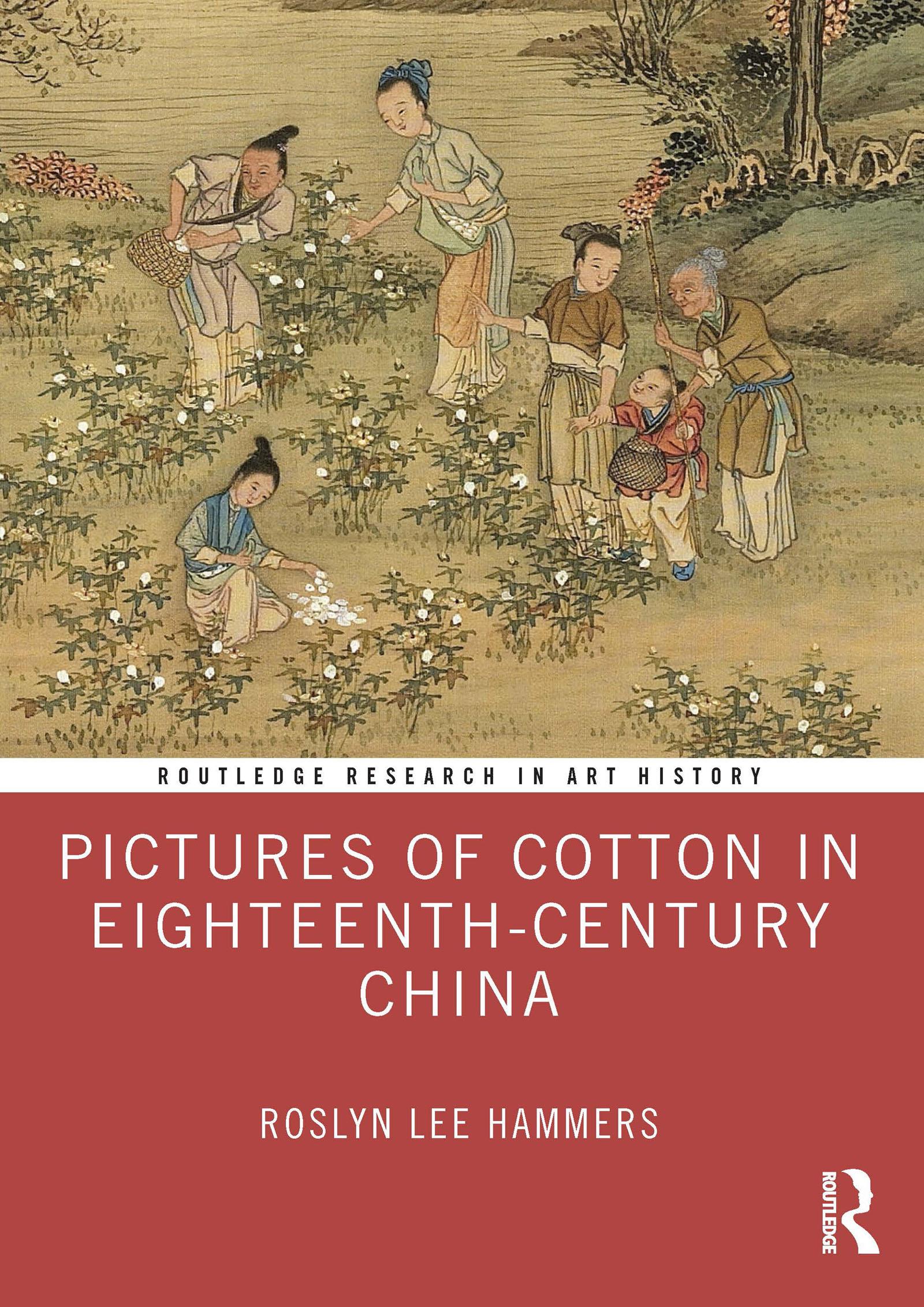
Pictures of Cotton in Eighteenth-Century China narrates cotton’s journey from a little understand material to a cherished commodity ennobled by associations with the classical heritage of China. In the 12th century, cotton, an imported crop, was plucked from the fields and entered the margins of agricultural treatises. The material was eventually “acknowledged” as cotton, an object distinct from silk, worthy of representation. By the late 16th century, representations of the plant and of the labor used to process it were incorporated into agricultural publications. During the 18th century, cotton imagery and discussions were situated in imperial encyclopaedias, further consolidating its classical legacy. Governor-general Fang Guancheng (1696/8-1768) deemed cotton a worthy subject for ambitious painting. In 1765, he designed the Pictures of Cotton, a series of sixteen paintings complete with commentary that delineated the processes of growing cotton and manufacturing fabric. He presented the Pictures of Cotton to the Qianlong emperor (r. 1735-1796) who inscribed his imperial verse on each scene. Knowledge about the fiber became a means to collaborate at the highest level of the court and bureaucracy. Fang replicated the series, complete with imperial verses into carved stone to enable replication. The Jiaqing emperor (r.1796-1821) likewise published the series as woodblock prints. Upon domestication, cotton advanced political legitimacy, becoming a commodity that attained canonical status. Cotton was represented in a scopic regime formulated by the Qing imperium, and in the process, the Imperially Inscribed Pictures of Cotton became the authoritative vision of cotton.
This study is ideal for those studying Chinese art, Chinese history, Asian Studies, and history of science and technology.’
Payez facilement par carte, Klarna, Apple Pay ou Google Pay. Pas satisfait ? Vous avez toujours une garantie de remboursement de 14 jours. En savoir plus dans nos conditions. Si vous avez des questions, envoyez-nous un e-mail à hello@memmo.org.
Memmo facilite tes études, où que tu sois dans le monde. On rassemble tes manuels de cours et des outils d'étude intelligents au même endroit : résumés, quiz, podcasts et flashcards. Et il y a Ted, ton compagnon d'étude qui répond à toutes tes questions. Plus de 50 000 étudiants étudient déjà ici – conçu pour t'aider à apprendre plus vite et à moins stresser.