
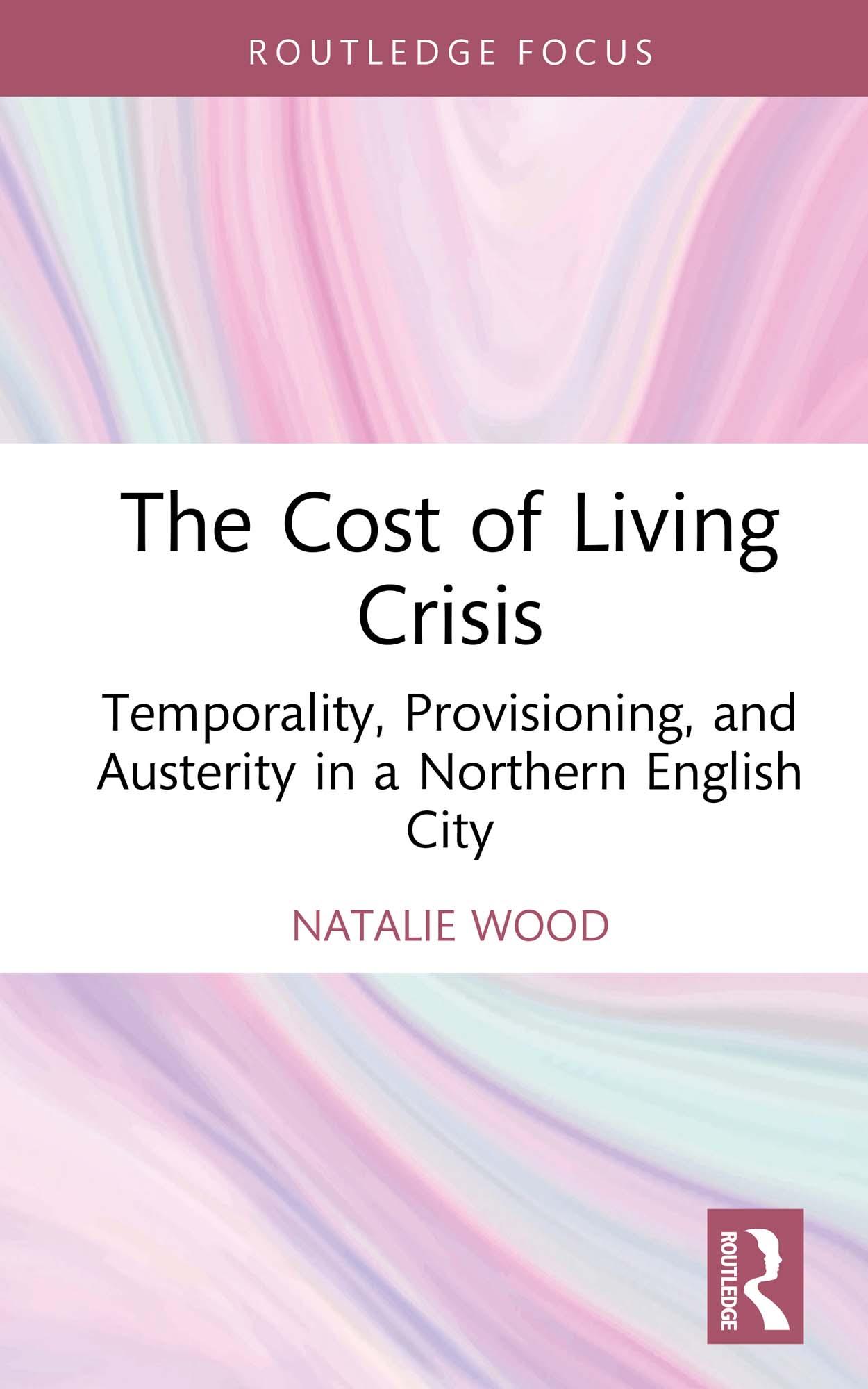
Set in the Northern English City of Leeds, in the midst of Liz Truss’ 49 days in office, what we are now calling The Cost of Living Crisis emerges as the most recent incantation of economic decline. Challenging the ease with which this phrase has become commonplace, this monograph provokes questions of when and for whom it became normal to discuss the cost of being alive.
The Cost of Living Crisis is both new and not new. With a focus on how economic decline is temporally experienced, Wood explores how consumption habits find solidarity with the past, claim membership in the present and grasp at uncertain futures. With a concern for where agency lies, Wood ultimately asks us: How is it that people deal, engage and reclaim precarious futures in the shop? Drawing from research conducted in a food pantry – a food bank that simulates a shop – Wood takes up a concept of provisioning as embodied knowledge and cultivated competence defined by the normalisation of economic recession. However, amidst hopelessness, the food pantry also materialises everyday acts of hope, care and play, which, in turn, perhaps provoke a reimagination not just of what a food bank is but of what shopping could be.
This book is applicable to scholars of temporality, political and economic anthropology, the anthropology of Britain, economic crisis and consumption.
Payez facilement par carte, Klarna, Apple Pay ou Google Pay. Pas satisfait ? Vous avez toujours une garantie de remboursement de 14 jours. En savoir plus dans nos conditions. Si vous avez des questions, envoyez-nous un e-mail à hello@memmo.org.
Memmo facilite tes études, où que tu sois dans le monde. On rassemble tes manuels de cours et des outils d'étude intelligents au même endroit : résumés, quiz, podcasts et flashcards. Et il y a Ted, ton compagnon d'étude qui répond à toutes tes questions. Plus de 50 000 étudiants étudient déjà ici – conçu pour t'aider à apprendre plus vite et à moins stresser.