
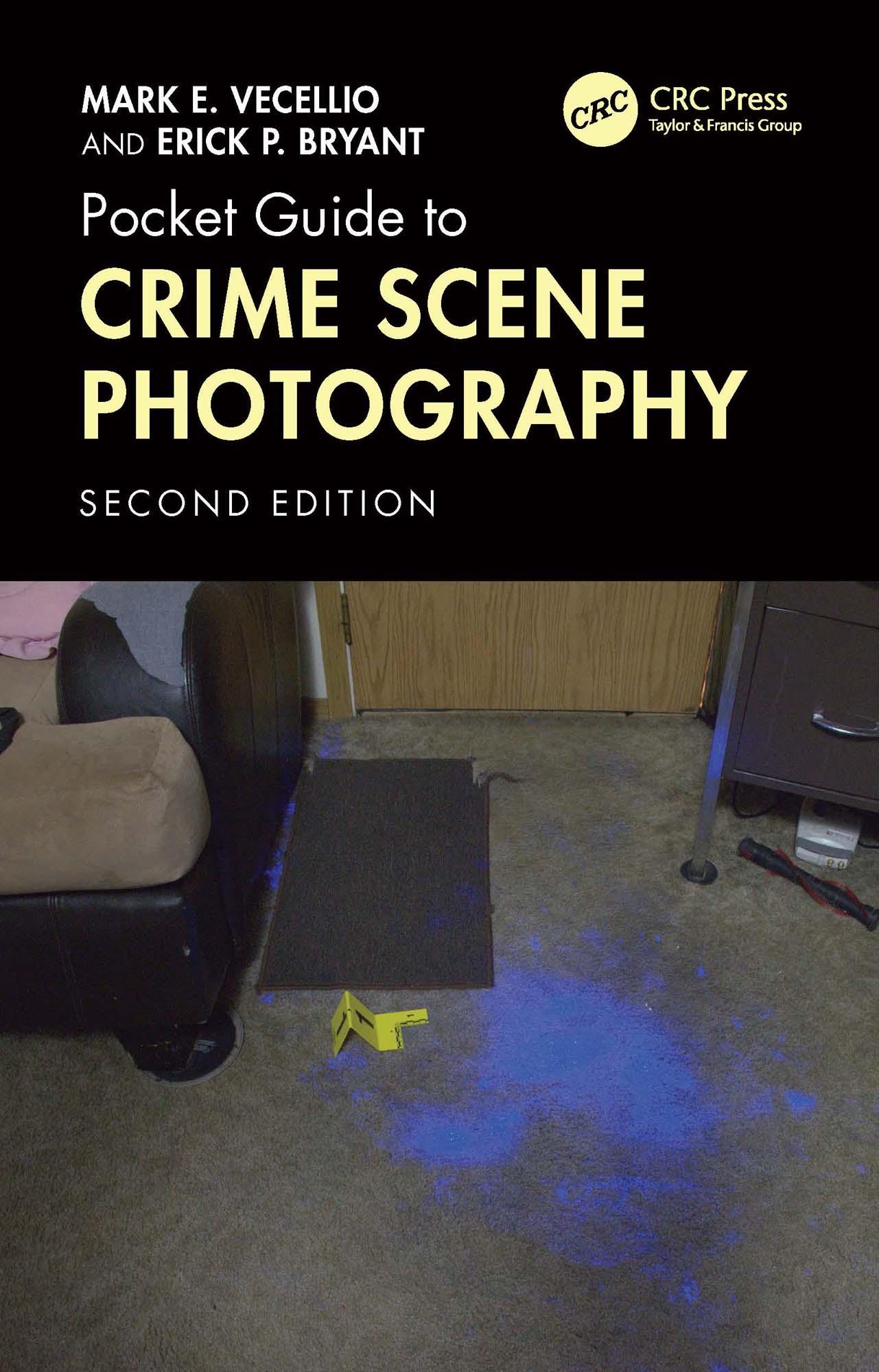
There are more than 800,000 sworn law enforcement officers employed within the United States, many of whom are regularly tasked with photographing crime scenes or evidence associated with criminal investigations. Despite this fact, law enforcement personnel—including detectives and crime scene investigators—frequently receive little to no formal training in the art and science of photography, let alone for capturing photographic evidence for forensic casework and future legal proceedings.
Unlike other resources on the topic that often contain overly complicated or rife with unnecessary or confusing technical jargon—this edition of Pocket Guide to Crime Scene Photography follows in the tradition of the first. The book is wholly updated, based on best practices and advances in camera technology to provide a practical, streamlined approach guide to the photographic documentation of crime scenes and physical evidence. The coverage includes extensive illustrations with two completely new chapters. The first focuses on specialized instructions for photographing shooting incident scenes, bloodstains, and evidence, made visible through infrared light; the is second dedicated to offering advice for photographing crime scenes and evidence with mobile device cameras.
Chapters distill the technical jargon and complex processes of photographing crime scenes and evidence into straightforward step-by-step descriptions. Pocket Guide to Crime Scene Photography, Second Edition has been designed in a smaller, handy trim size as a convenient, portable tool to help busy professionals. Its techniques include practical guidelines that can be immediately implemented by law enforcement personnel to maximize their time and improve their skills.
Features:
- Provides an up-to-date, portable reference ideal for use in the field; includes full-color photographs throughout to illustrate key concepts
- Details how to document various types of evidence, and crime scenes, using both standard and specialized techniques
- Outlines visualization and photography of evidence—illuminated with alternative light sources—including visible wavelengths, UV, and infrared
- Presents guidance for personnel who might only be able to use cell phone cameras for photographing evidence and scenes
- Written by two experienced professionals who know the investigative and courtroom requirements for quality admissible photos.
Payez facilement par carte, Klarna, Apple Pay ou Google Pay. Pas satisfait ? Vous avez toujours une garantie de remboursement de 14 jours. En savoir plus dans nos conditions. Si vous avez des questions, envoyez-nous un e-mail à hello@memmo.org.
Memmo facilite tes études, où que tu sois dans le monde. On rassemble tes manuels de cours et des outils d'étude intelligents au même endroit : résumés, quiz, podcasts et flashcards. Et il y a Ted, ton compagnon d'étude qui répond à toutes tes questions. Plus de 50 000 étudiants étudient déjà ici – conçu pour t'aider à apprendre plus vite et à moins stresser.