
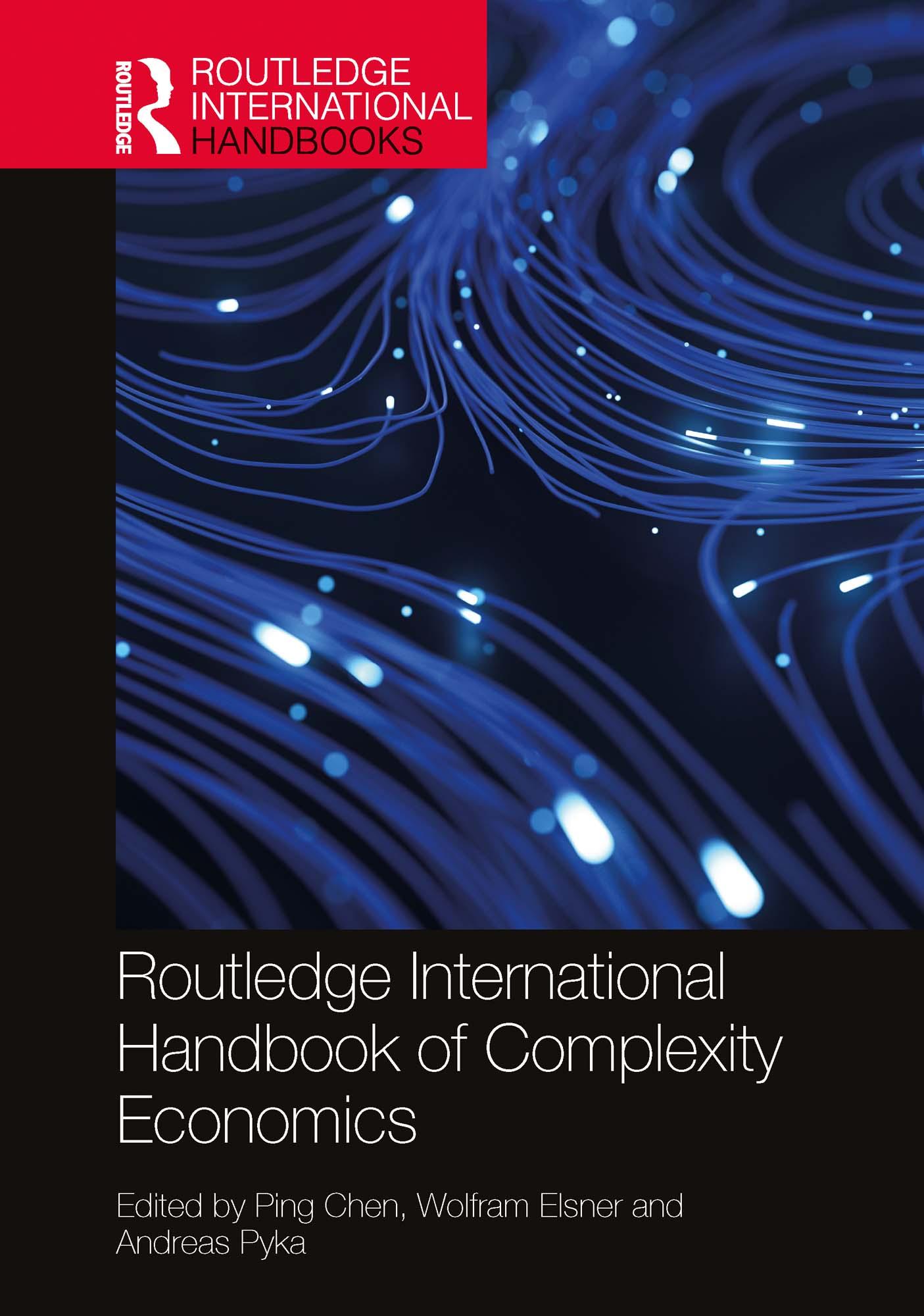
The Routledge International Handbook of Complexity Economics covers the historical developments and early concerns of complexity theorists and brings them into engagement with the world today.
In this volume, a distinguished group of international scholars explore the state of the art of complexity economics, and how it may deliver new and relevant insights to the challenges of the 21st century. Complexity science started in 1899 when Henri Poincaré described the three-body problem. The first approaches in economics emerged somewhat later, in the 1980s, driven by the Brussels-Austin school. Since then, complexity economics has gone through numerous developments: departing from linear simplifications, applying physical algorithms, to evolutionary economics and big data. This book covers the basic principles and methods, and offers an overview of the various domains—ranging from diverse fields of productivity studies, agricultural economics, to monetary economics—as well as the current challenges such as climate change, epidemics and economic inequality where complexity economics can provide insight. It closes with a review of complexity political economy and policy.
Offering a vibrant alternative to orthodox economics, this handbook is a crucial resource for advanced students, researchers and economists across the disciplines of heterodox economics, economic theory and econophysics.
Payez facilement par carte, Klarna, Apple Pay ou Google Pay. Pas satisfait ? Vous avez toujours une garantie de remboursement de 14 jours. En savoir plus dans nos conditions. Si vous avez des questions, envoyez-nous un e-mail à hello@memmo.org.
Memmo facilite tes études, où que tu sois dans le monde. On rassemble tes manuels de cours et des outils d'étude intelligents au même endroit : résumés, quiz, podcasts et flashcards. Et il y a Ted, ton compagnon d'étude qui répond à toutes tes questions. Plus de 50 000 étudiants étudient déjà ici – conçu pour t'aider à apprendre plus vite et à moins stresser.