
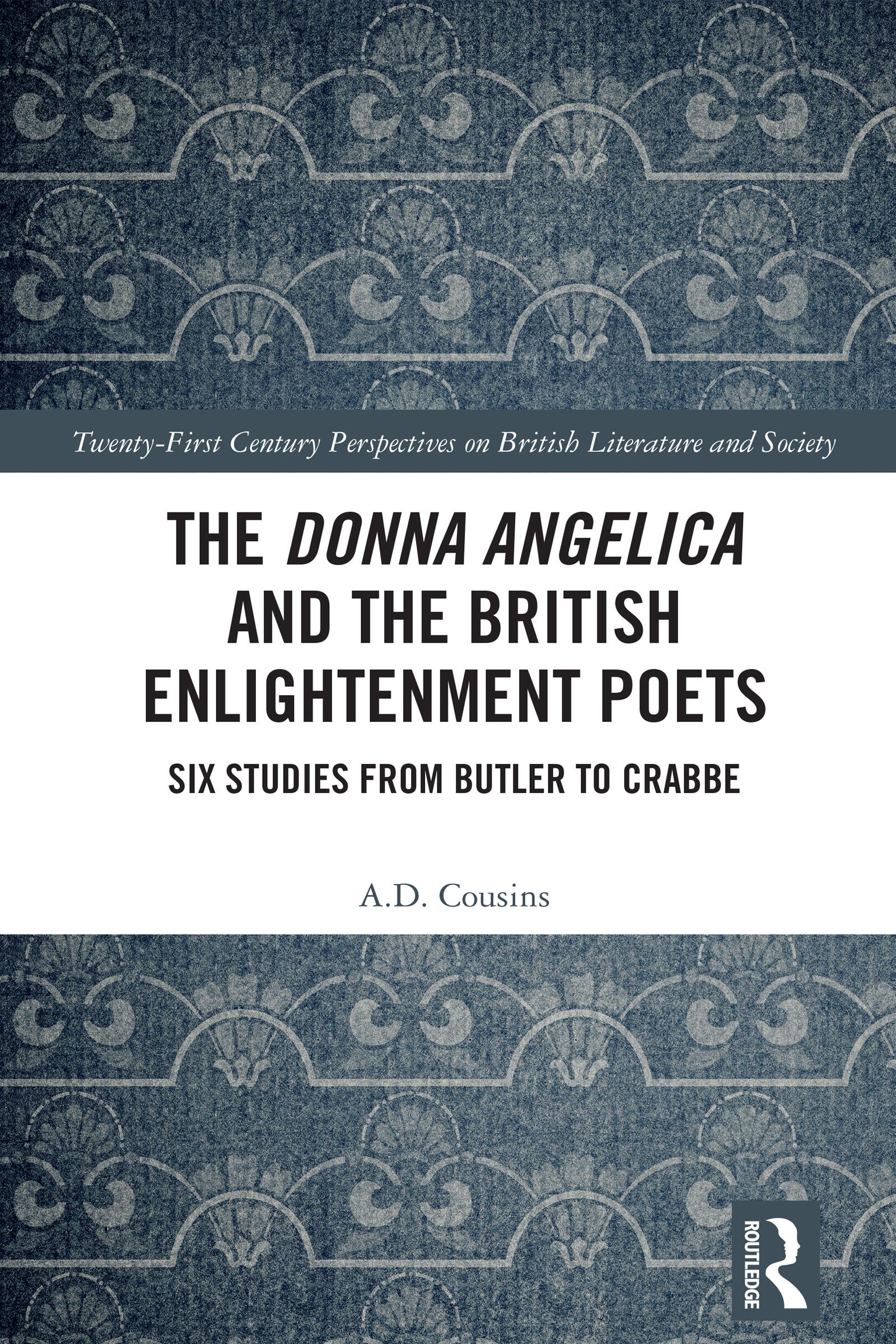
The aim of the book is to propose new interpretations of poets who are among the most valued and discussed in the British Enlightenment. In fulfilling its aim, the book covers English poetry—and intellectual history—from the Restoration to the later eighteenth century. It examines how the myth of the donna angelica (the angelic lady), ancient in origin but given its best-known form within the medieval literature of fin’amor, lives on beyond the Middle Ages and the Renaissance into the Enlightenment. To be more precise, it studies how some major Augustan poets appropriate and recreate what, for convenience, can be called the donna angelica topos (or, the angelic lady motif). They do so for a great many reasons linked with quite diverse circumstances. Nevertheless, the myth’s intellectual richness, emotional intensity, and inherent ambiguities mean that it offers each of them a powerful way for articulating, interpreting, exploring refractions of eros—whether singly or diversely directed, concerned with sexuality or spirituality, informing personal or public experience. The myth has as many faces, so to speak, as does desire; it is one and yet many. Thus, the book pursues a particular fable of eros that appears in a multiplicity of texts in a multiplicity of guises. It studies how some of the most interesting poets from Dryden to Crabbe bring the angelic lady motif into modernity.
Payez facilement par carte, Klarna, Apple Pay ou Google Pay. Pas satisfait ? Vous avez toujours une garantie de remboursement de 14 jours. En savoir plus dans nos conditions. Si vous avez des questions, envoyez-nous un e-mail à hello@memmo.org.
Memmo facilite tes études, où que tu sois dans le monde. On rassemble tes manuels de cours et des outils d'étude intelligents au même endroit : résumés, quiz, podcasts et flashcards. Et il y a Ted, ton compagnon d'étude qui répond à toutes tes questions. Plus de 50 000 étudiants étudient déjà ici – conçu pour t'aider à apprendre plus vite et à moins stresser.