
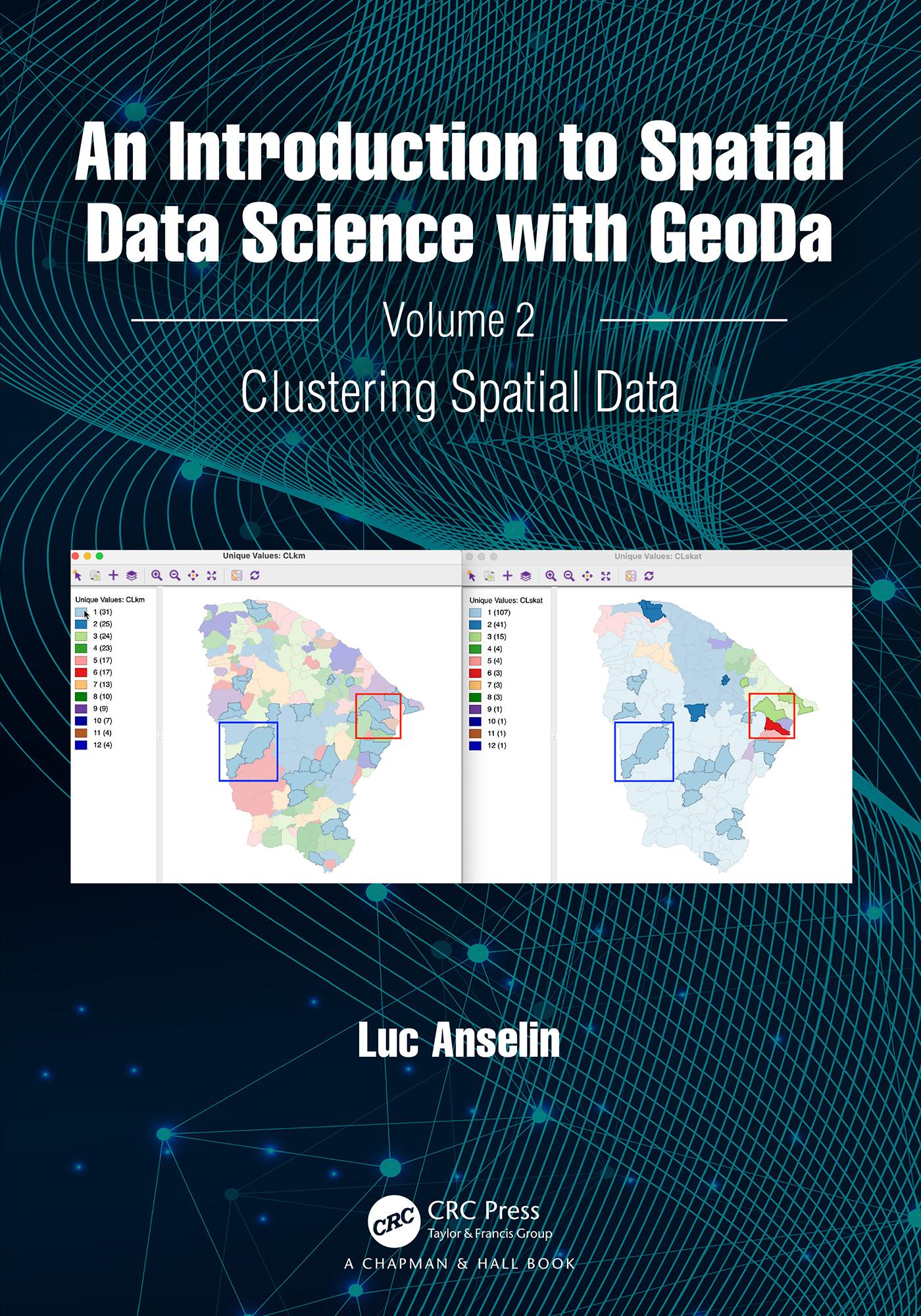
This book is the second in a two-volume series that introduces the field of spatial data science. It moves beyond pure data exploration to the organization of observations into meaningful groups, i.e., spatial clustering. This constitutes an important component of so-called unsupervised learning, a major aspect of modern machine learning.
The distinctive aspects of the book are both to explore ways to spatialize classic clustering methods through linked maps and graphs, as well as the explicit introduction of spatial contiguity constraints into clustering algorithms. Leveraging a large number of real-world empirical illustrations, readers will gain an understanding of the main concepts and techniques and their relative advantages and disadvantages. The book also constitutes the definitive user’s guide for these methods as implemented in the GeoDa open source software for spatial analysis.
It is organized into three major parts, dealing with dimension reduction (principal components, multidimensional scaling, stochastic network embedding), classic clustering methods (hierarchical clustering, k-means, k-medians, k-medoids and spectral clustering), and spatially constrained clustering methods (both hierarchical and partitioning). It closes with an assessment of spatial and non-spatial cluster properties.
The book is intended for readers interested in going beyond simple mapping of geographical data to gain insight into interesting patterns as expressed in spatial clusters of observations. Familiarity with the material in Volume 1 is assumed, especially the analysis of local spatial autocorrelation and the full range of visualization methods.
Payez facilement par carte, Klarna, Apple Pay ou Google Pay. Pas satisfait ? Vous avez toujours une garantie de remboursement de 14 jours. En savoir plus dans nos conditions. Si vous avez des questions, envoyez-nous un e-mail à hello@memmo.org.
Memmo facilite tes études, où que tu sois dans le monde. On rassemble tes manuels de cours et des outils d'étude intelligents au même endroit : résumés, quiz, podcasts et flashcards. Et il y a Ted, ton compagnon d'étude qui répond à toutes tes questions. Plus de 50 000 étudiants étudient déjà ici – conçu pour t'aider à apprendre plus vite et à moins stresser.