
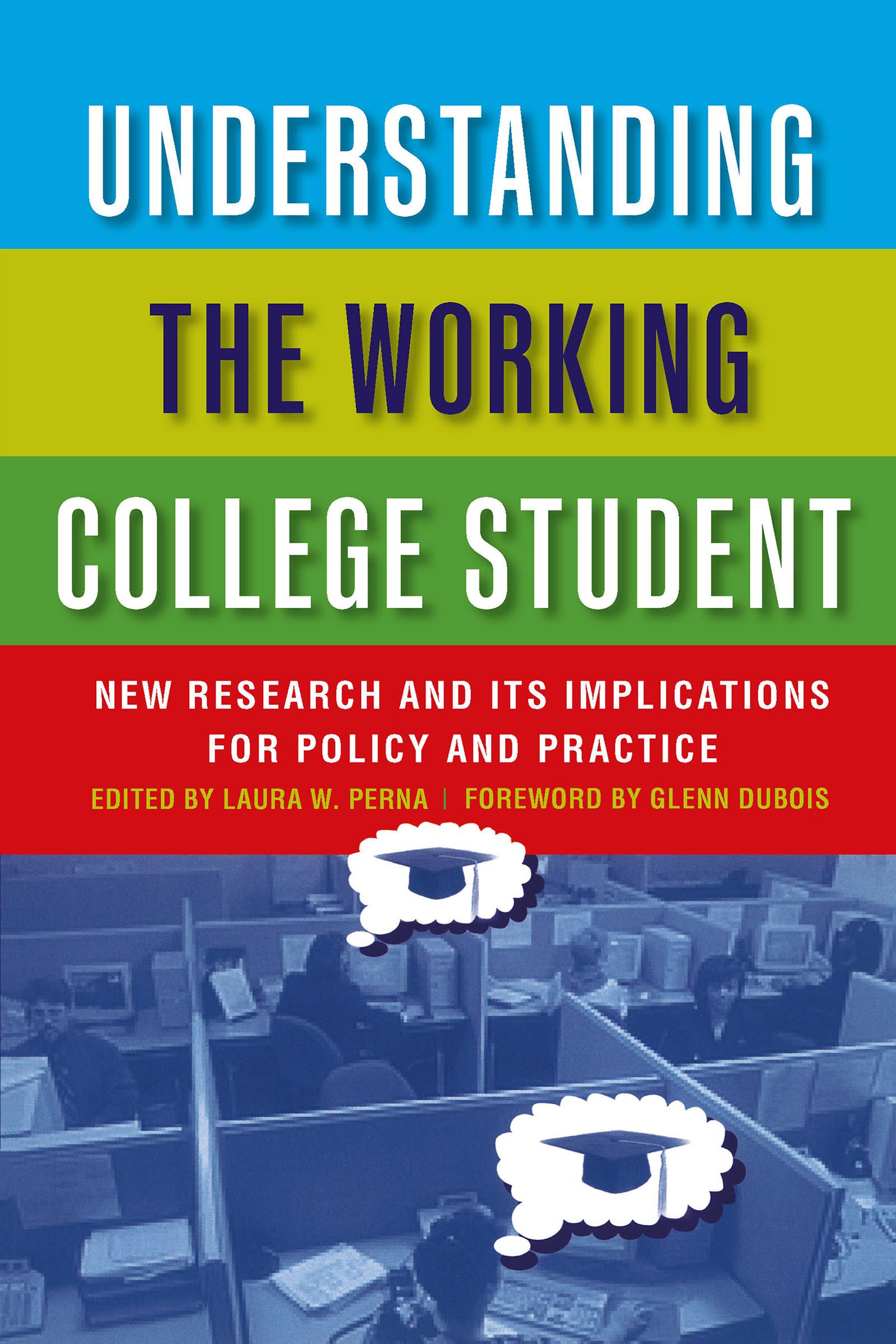
How appropriate for today and for the future are the policies and practices of higher education that largely assume a norm of traditional-age students with minimal on-campus, or no, work commitments?Despite the fact that work is a fundamental part of life for nearly half of all undergraduate students – with a substantial number of “traditional” dependent undergraduates in employment, and working independent undergraduates averaging 34.5 hours per week – little attention has been given to how working influences the integration and engagement experiences of students who work, especially those who work full-time, or how the benefits and costs of working differ between traditional age-students and adult students.The high, and increasing, prevalence and intensity of working among both dependent and independent students raises a number of important questions for public policymakers, college administrators, faculty, academic advisors, student services and financial aid staff, and institutional and educational researchers, including: Why do so many college students work so many hours? What are the characteristics of undergraduates who work? What are the implications of working for students’ educational experiences and outcomes? And, how can public and institutional policymakers promote the educational success of undergraduate students who work? This book offers the most complete and comprehensive conceptualization of the “working college student” available. It provides a multi-faceted picture of the characteristics, experiences, and challenges of working college students and a more complete understanding of the heterogeneity underlying the label “undergraduates who work” and the implications of working for undergraduate students’ educational experiences and outcomes. The volume stresses the importance of recognizing the value and contribution of adult learners to higher education, and takes issue with the appropriateness of the term “non-traditional” itself, both because of the prevalence of this group, and because it allows higher education institutions to avoid considering changes that will meet the needs of this population, including changes in course offerings, course scheduling, financial aid, and pedagogy.
Payez facilement par carte, Klarna, Apple Pay ou Google Pay. Pas satisfait ? Vous avez toujours une garantie de remboursement de 14 jours. En savoir plus dans nos conditions. Si vous avez des questions, envoyez-nous un e-mail à hello@memmo.org.
Memmo facilite tes études, où que tu sois dans le monde. On rassemble tes manuels de cours et des outils d'étude intelligents au même endroit : résumés, quiz, podcasts et flashcards. Et il y a Ted, ton compagnon d'étude qui répond à toutes tes questions. Plus de 50 000 étudiants étudient déjà ici – conçu pour t'aider à apprendre plus vite et à moins stresser.