
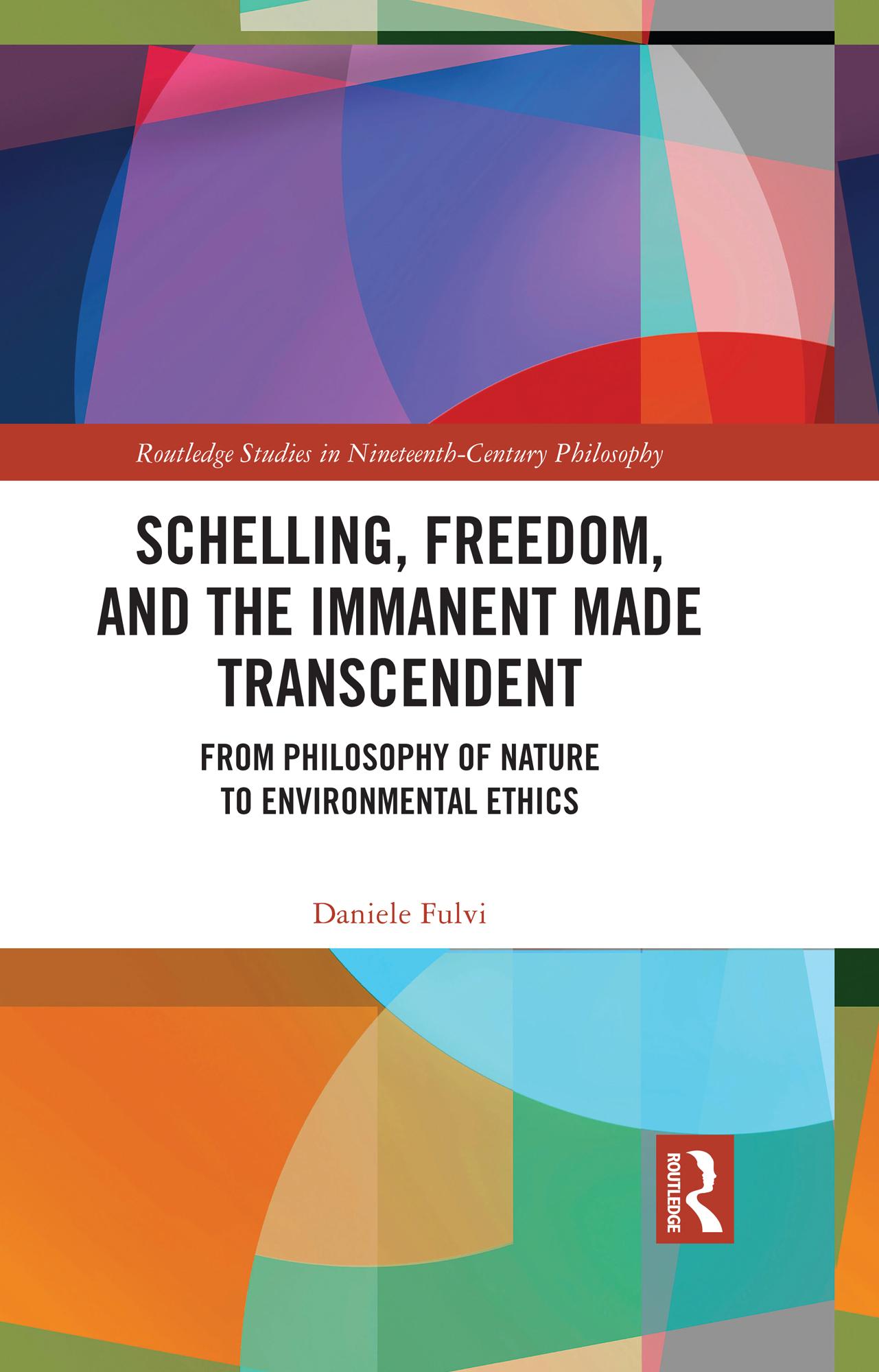
This book offers a cutting-edge interpretation of the philosophy of F.W.J. Schelling by critically reconsidering the interpretations of some of his “successors.” It argues that Schelling’s philosophy should be read as an ontology of immanence, highlighting its relevance for ongoing debates on ethics and freedom.
The book builds on a key notion from Schelling’s Philosophy of Revelation where he outlines the process through which transcendence must return to immanence in order to be grasped and understood. The author identifies Jaspers, Heidegger, and Deleuze as the main interpreters of Schelling’s philosophical activity, highlighting their relevance for subsequent Schelling scholarship. Heidegger and Jaspers refer to Schelling’s philosophy in negative terms, namely as an incomplete and unviable philosophical system, whereas Deleuze holds the immanent core of Schelling’s ontological discourse in high regard. The author’s analysis demonstrates that reading Schelling’s philosophy as an ontology of immanence not only avoids Heidegger’s and Jaspers’s criticisms but is also more fitting to Schelling’s original meaning. Accordingly, his reading allows us to fully grasp Schelling’s thought in all its strength and consistency: as a philosophy that avoids metaphysical abstractions and maintains the concreteness of concepts like God, nature, freedom by binding them to a solid and material account of Being. Finally, the author uses Schelling to propose an innovative reading of freedom as a matter of resistance, and of philosophy as an activity whose main purpose is that of seeking the actual extent and place of (human) life and freedom within nature. The author originally emphasises the relevance of these conclusions on contemporary debates in Postcolonial Critical Theory and Environmental Ethics.
Schelling, Freedom, and the Immanent Made Transcendent. From Philosophy of Nature to Environmental Ethics will appeal to scholars and advanced students working in 19th-century Continental philosophy, German idealism, and Postcolonial Critical Theory and Environmental Ethics.
Payez facilement par carte, Klarna, Apple Pay ou Google Pay. Pas satisfait ? Vous avez toujours une garantie de remboursement de 14 jours. En savoir plus dans nos conditions. Si vous avez des questions, envoyez-nous un e-mail à hello@memmo.org.
Memmo facilite tes études, où que tu sois dans le monde. On rassemble tes manuels de cours et des outils d'étude intelligents au même endroit : résumés, quiz, podcasts et flashcards. Et il y a Ted, ton compagnon d'étude qui répond à toutes tes questions. Plus de 50 000 étudiants étudient déjà ici – conçu pour t'aider à apprendre plus vite et à moins stresser.