
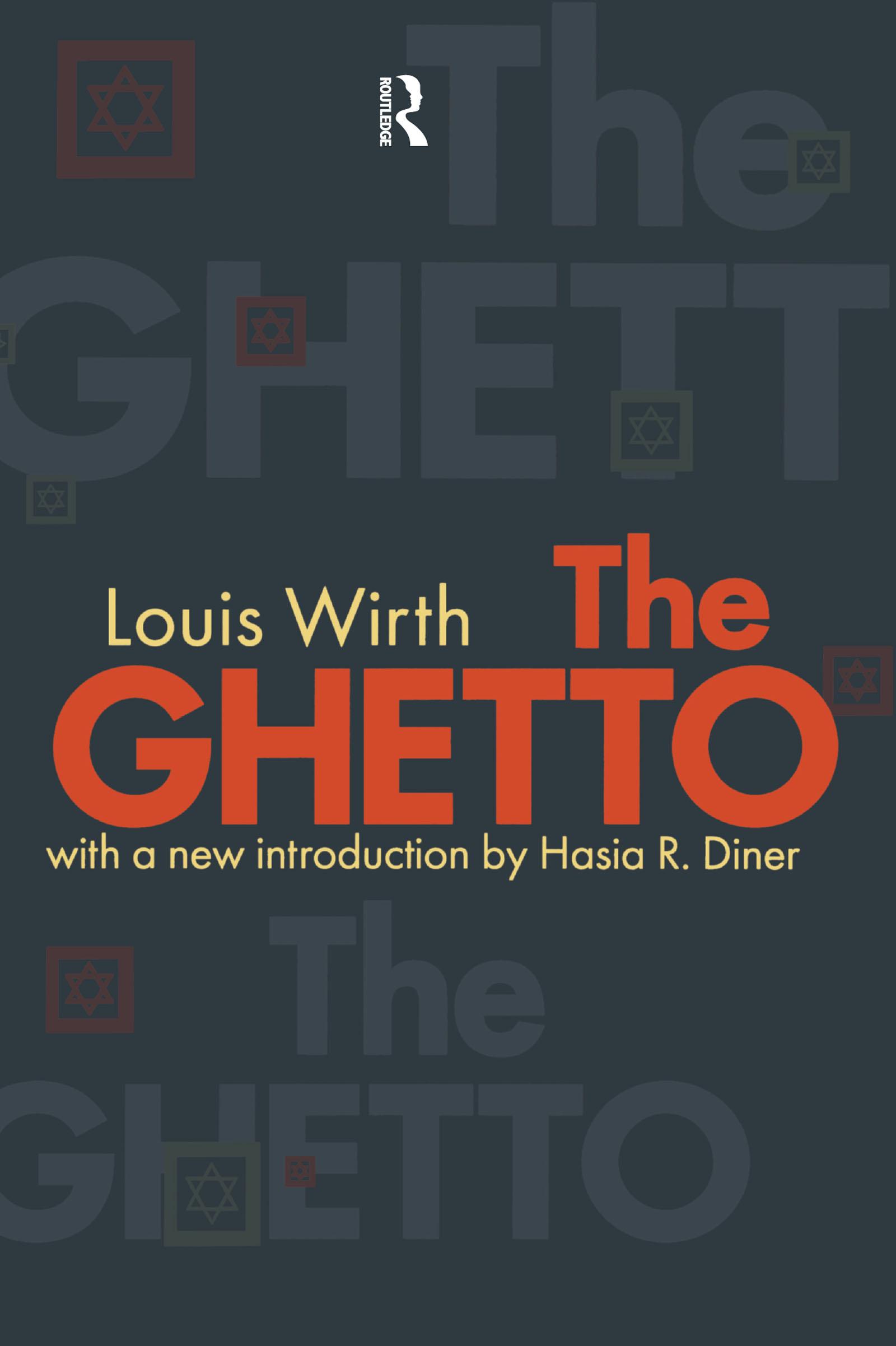
When The Ghetto first appeared seventy years ago, Bruno Lasker in the New York Times called it "the most informing general account of the cultural background and psychological development of the American Jew." Arguably, the book still occupies this special niche in ethnic studies. Hasia Diner's extensive new introduction, in itself an important contribution to the history of sociological ideas, points out that The Ghetto "stands in a class by itself as a piece of scholarship of the early twentieth century." That judgment stands.
The Ghetto traces back to the medieval era the Jewish immigrant colonies that have virtually disappeared from our modern cities—to be replaced by other ghettoes. Analytical as well as historical, Wirth's book lays bare the rich inner life hidden behind the drab exterior of the ghetto. The book describes the significant physical, social, and psychic influences of ghetto life upon the Jews. Wirth demonstrates that the economic life of the modern Jew still reflects the impress of the social isolation of ghetto life; at first self-imposed, later formalized, and finally imposed by others through a variety of extralegal mechanisms. He presents a faithful picture of an environment now largely vanished and illustrates a sociological method in so doing.
In his foreword to the book, Robert E. Park reminds us that the city is not merely an artifact but an organism. Its growth is often uncontrolled and undesigned. The forms it tends to assume are those which represent and correspond to the functions that it is called upon to perform. The Ghetto will be important to scholars in Jewish studies, the history of sociology, American ethnic history, and social history. This volume is the second in a series of studies in ethnicity edited by Ronald H. Bayor of the Georgia Institute of Technology.
Payez facilement par carte, Klarna, Apple Pay ou Google Pay. Pas satisfait ? Vous avez toujours une garantie de remboursement de 14 jours. En savoir plus dans nos conditions. Si vous avez des questions, envoyez-nous un e-mail à hello@memmo.org.
Memmo facilite tes études, où que tu sois dans le monde. On rassemble tes manuels de cours et des outils d'étude intelligents au même endroit : résumés, quiz, podcasts et flashcards. Et il y a Ted, ton compagnon d'étude qui répond à toutes tes questions. Plus de 50 000 étudiants étudient déjà ici – conçu pour t'aider à apprendre plus vite et à moins stresser.