
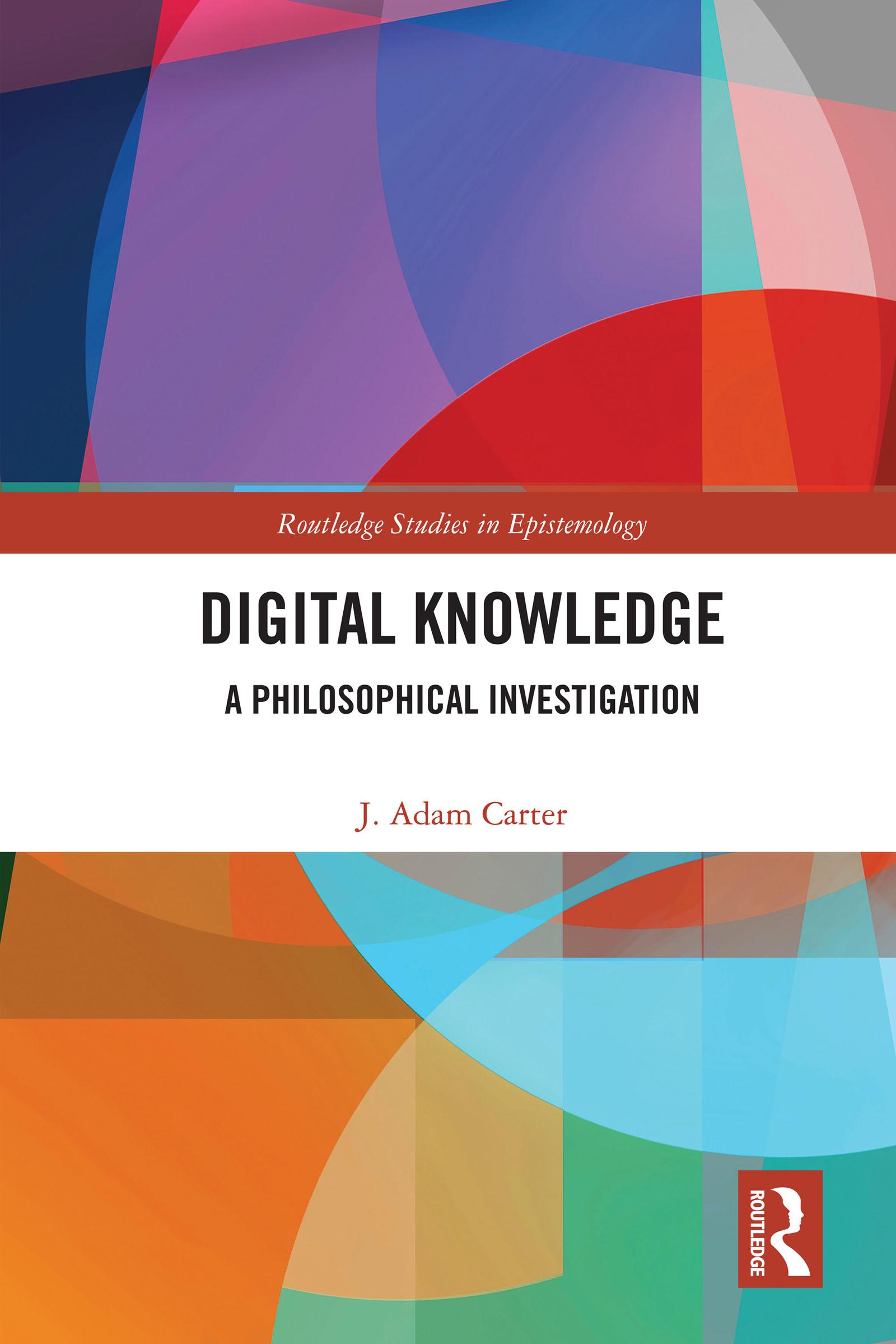
Information we use to structure our lives is increasingly stored digitally, rather than in biomemory. (Just think: if your online calendar went down, would you know where you are supposed to be and at what time next week?) Likewise, with breakthroughs such as those from Google DeepMind and OpenAI, discoveries at the frontiers of knowledge are increasingly due to machine learning (often, applied to massive datasets, extracted from a fast-growing datasphere) rather than to brainbound cognition. It’s hard to deny that knowledge retention and production are becoming increasingly – in various ways – digitised.
Digital Knowledge: A Philosophical Investigation is the first book to squarely and rigorously investigate digital knowledge: what it is, how to make sense of it in connection with received theories of knowledge, and where it is going. Key questions J. Adam Carter examines along the way are the following:
- How is mere digital information converted into reliable digital knowledge?
- To what extent can digital knowledge be vindicated against sceptical challenges, and in what ways might digital knowledge stand distinctively subject to defeat?
- What is the epistemically optimal way for us to decide which tasks to outsource entirely to intelligent machines, and to what extent is further outsourcing appropriate (or not) to verify the results of that same outsourced cognition?
- Are there any ways in which the expansion of the datasphere threatens to make knowledge less, rather than more, easy to come by? If so, are there any promising ways to safeguard, epistemically, against such threats?
Using fascinating examples throughout, such as the recent chess match between Stockfish and Google’s AlphaZero, smartphones and personalisation, Digital Knowledge: A Philosophical Investigation is ideal for researchers investigating this fascinating area of research at the intersection of traditional mainstream epistemology, the philosophy of cognitive science, the philosophy of technology, and computer science.
Payez facilement par carte, Klarna, Apple Pay ou Google Pay. Pas satisfait ? Vous avez toujours une garantie de remboursement de 14 jours. En savoir plus dans nos conditions. Si vous avez des questions, envoyez-nous un e-mail à hello@memmo.org.
Memmo facilite tes études, où que tu sois dans le monde. On rassemble tes manuels de cours et des outils d'étude intelligents au même endroit : résumés, quiz, podcasts et flashcards. Et il y a Ted, ton compagnon d'étude qui répond à toutes tes questions. Plus de 50 000 étudiants étudient déjà ici – conçu pour t'aider à apprendre plus vite et à moins stresser.