
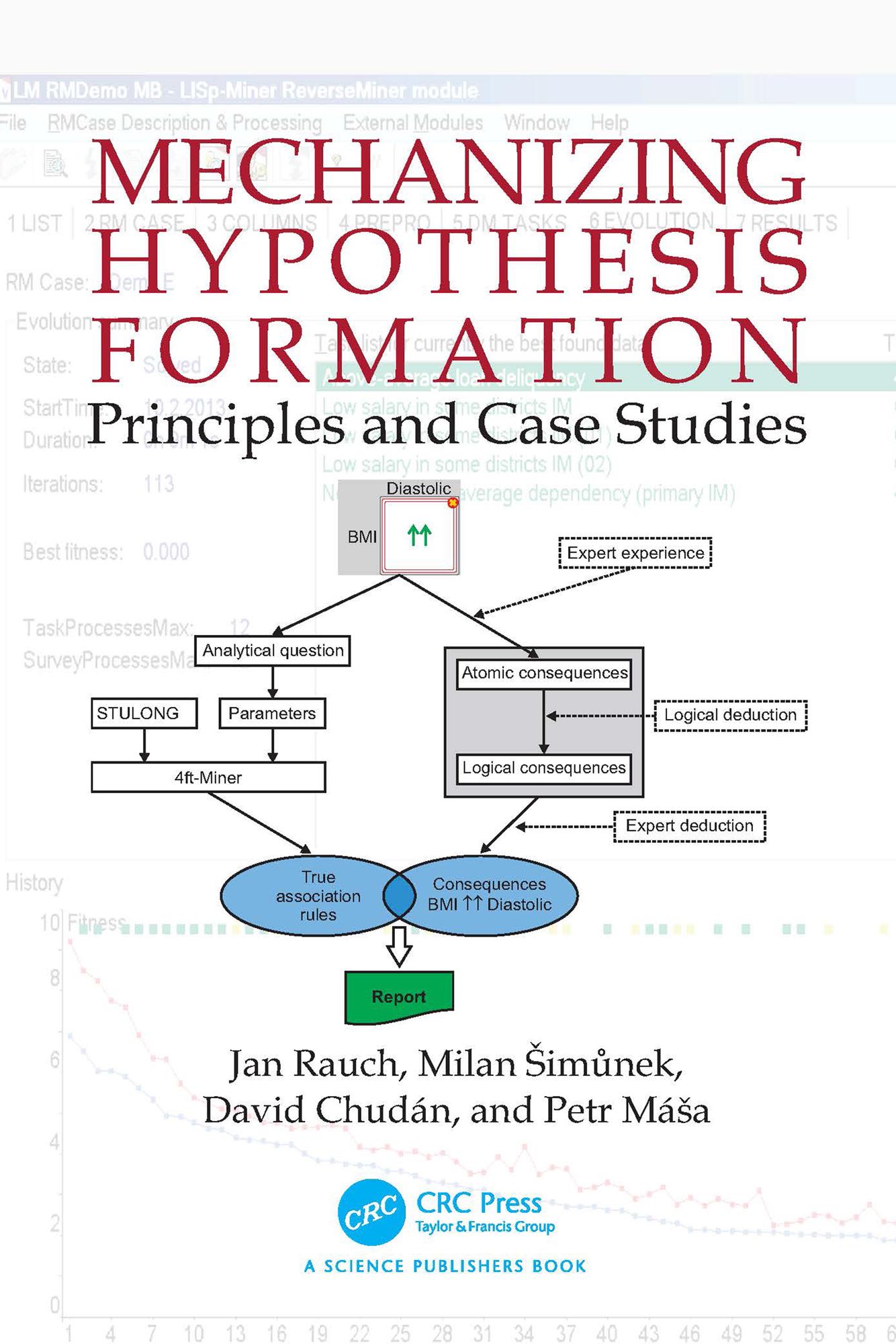
Mechanizing hypothesis formation is an approach to exploratory data analysis. Its development started in the 1960s inspired by the question “can computers formulate and verify scientific hypotheses?”. The development resulted in a general theory of logic of discovery. It comprises theoretical calculi dealing with theoretical statements as well as observational calculi dealing with observational statements concerning finite results of observation. Both calculi are related through statistical hypotheses tests. A GUHA method is a tool of the logic of discovery. It uses a one-to-one relation between theoretical and observational statements to get all interesting theoretical statements. A GUHA procedure generates all interesting observational statements and verifies them in a given observational data. Output of the procedure consists of all observational statements true in the given data. Several GUHA procedures dealing with association rules, couples of association rules, action rules, histograms, couples of histograms, and patterns based on general contingency tables are involved in the LISp-Miner system developed at the Prague University of Economics and Business. Various results about observational calculi were achieved and applied together with the LISp-Miner system.
The book covers a brief overview of logic of discovery. Many examples of applications of the GUHA procedures to solve real problems relevant to data mining and business intelligence are presented. An overview of recent research results relevant to dealing with domain knowledge in data mining and its automation is provided. Firsthand experiences with implementation of the GUHA method in the Python language are presented.
Payez facilement par carte, Klarna, Apple Pay ou Google Pay. Pas satisfait ? Vous avez toujours une garantie de remboursement de 14 jours. En savoir plus dans nos conditions. Si vous avez des questions, envoyez-nous un e-mail à hello@memmo.org.
Memmo facilite tes études, où que tu sois dans le monde. On rassemble tes manuels de cours et des outils d'étude intelligents au même endroit : résumés, quiz, podcasts et flashcards. Et il y a Ted, ton compagnon d'étude qui répond à toutes tes questions. Plus de 50 000 étudiants étudient déjà ici – conçu pour t'aider à apprendre plus vite et à moins stresser.