
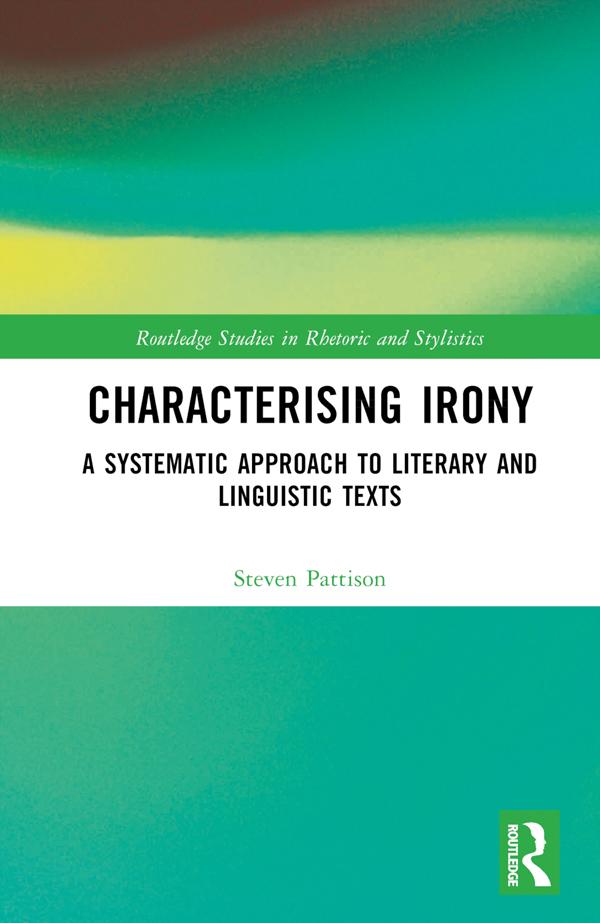
This book offers a systematic, bottom-up account of irony across both everyday contexts and literary and linguistic texts, using an empirically rigorous approach in distinguishing between central irony, non-central ironies, and non-ironies and highlighting a new way forward for irony research.
The volume considers the current landscape of irony, in which the term is used with increasing frequency with the knock-on effect of a loosening of its meaning. Pattison addresses this challenge by applying a systematic form of analysis, rooted in frameworks from pragmatics and complementary disciplines, to a database of over 500 irony candidates from a wide range of sources. The book uses these examples to illustrate the features of central ironies as well as the attributes used to differentiate between central ironies, non-central ironies, and non-ironies. These attributes are mapped across four key domains, including: difference and opposition; the role of context; how ironies are signaled; and speaker attitude and intention. Taken together, the volume puts forth a credible account for more clearly characterizing examples of irony and equips researchers with a comprehensive step-by-step method for undertaking future research.
This book is key reading for scholars in stylistics, pragmatics, literary studies, and psycholinguistics.
Payez facilement par carte, Klarna, Apple Pay ou Google Pay. Pas satisfait ? Vous avez toujours une garantie de remboursement de 14 jours. En savoir plus dans nos conditions. Si vous avez des questions, envoyez-nous un e-mail à hello@memmo.org.
Memmo facilite tes études, où que tu sois dans le monde. On rassemble tes manuels de cours et des outils d'étude intelligents au même endroit : résumés, quiz, podcasts et flashcards. Et il y a Ted, ton compagnon d'étude qui répond à toutes tes questions. Plus de 50 000 étudiants étudient déjà ici – conçu pour t'aider à apprendre plus vite et à moins stresser.