
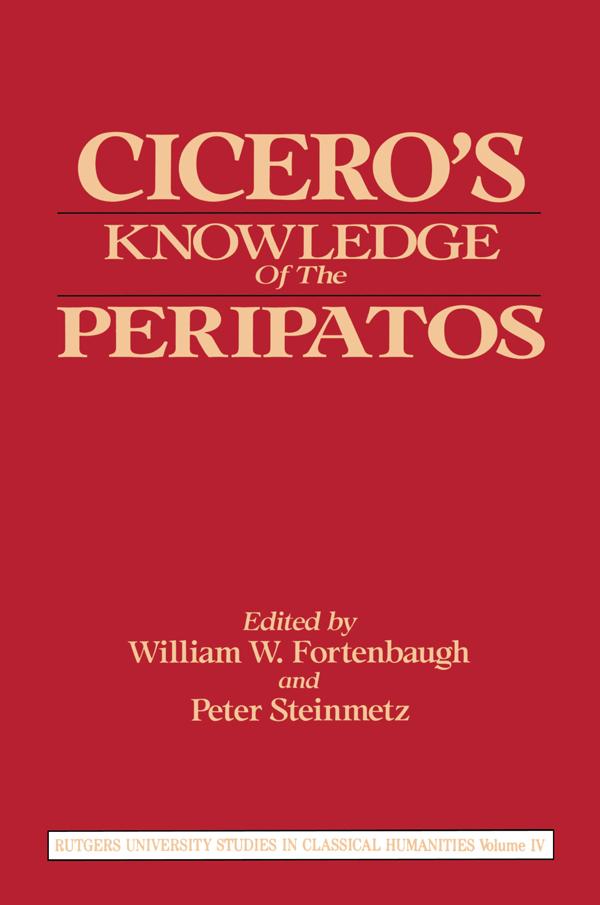
Cicero is best known for his political speeches. His Catilinarian orations are regularly studied in third or fourth year Latin; his self-proclaimed role as savior of the Republic is much discussed in courses on Roman history. But, however fascinating such material may be, there is another side to Cicero which is equally important and only now receiving the attention it deserves. This is Cicero's interest in Hellenistic thought. As a young man he studied philosophy in Greece; throughout his life he maintained a keen interest in intellectual history; and during periods of political inactivity - especially in his last years as the Republic collapsed - he wrote treatises that today are invaluable sources for our knowledge of Hellenistic philosophy, including the School of Aristotle.
The essays collected in this volume deal with these treatises and in particular with Cicero's knowledge of Peripatetic philosophy. They ask such questions as: Did Cicero-know Aristotle first hand, or was the corpus Aristotelicum unavailable to him and his contemporaries? Did Cicero have access to the writings of Theophrastus, and in general did he know the post-Aristotelians whose works are all but lost to us? When Cicero reports the views of early philosophers, is he a reliable witness, and is he conveying important information? These and other fundamental questions are asked with special reference to traditional areas of Greek thought: logic and rhetoric, politics and ethics, physics, psychology, and theology. The answers are various, but the overall impression is clear: Cicero himself was a highly intelligent, well educated Roman, whose treatises contain significant material. Scholars working on Peripatetic thought and on the Hellenistic period as a whole cannot afford to ignore them.
This fourth volume in the Rutgers University Studies in Classic Humanities series deals with Cicero, orator and writer of the late Roman Republic. Interest in Cicero arose out of Project Theophrastus, an international undertaking based at Rutgers dedicated to collecting, editing, and translating the fragments of Theophrastus. This collection will be of value to philologists, classicists, philosophers, as well as those interested in the history of science.
Payez facilement par carte, Klarna, Apple Pay ou Google Pay. Pas satisfait ? Vous avez toujours une garantie de remboursement de 14 jours. En savoir plus dans nos conditions. Si vous avez des questions, envoyez-nous un e-mail à hello@memmo.org.
Memmo facilite tes études, où que tu sois dans le monde. On rassemble tes manuels de cours et des outils d'étude intelligents au même endroit : résumés, quiz, podcasts et flashcards. Et il y a Ted, ton compagnon d'étude qui répond à toutes tes questions. Plus de 50 000 étudiants étudient déjà ici – conçu pour t'aider à apprendre plus vite et à moins stresser.