
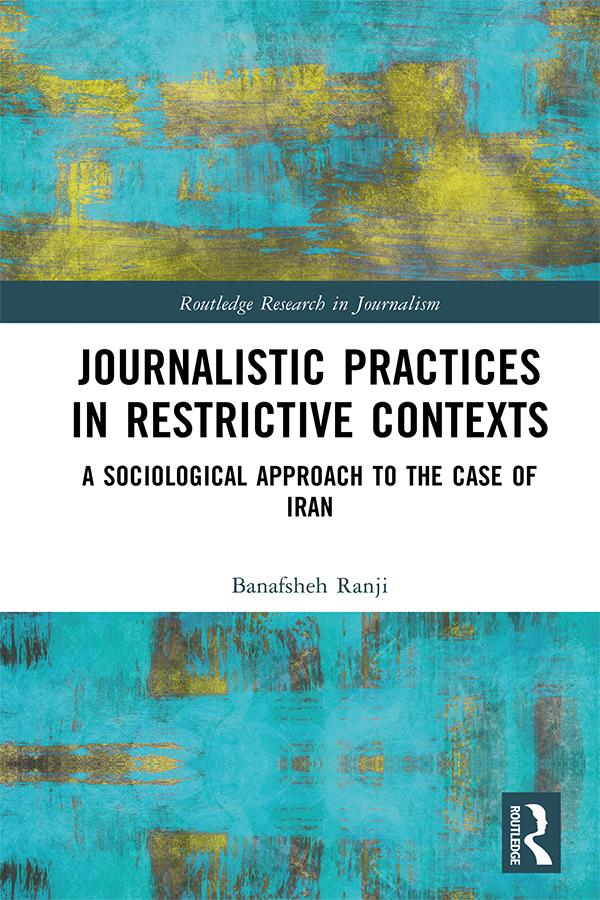
Based on fieldwork conducted in Iran, this book discusses how it is possible for journalism to exist and function in a restrictive context.
The book brings together a range of structural (macro), organizational (meso), and individual (micro) processes to analyze journalistic practice in a politically restrictive setting, a context thus far dominated by structural explanations. Using Pierre Bourdieu’s work as a starting point, Banafsheh Ranji develops an explanatory framework for how Iranian journalists navigate the daily 'minefield' of their professional environment. The analysis sheds light on the everyday reality of journalism in Iran, addressing factors that hinder journalists’ work while also showing how journalists use a set of double game strategies to simultaneously circumvent constraints and avoid retaliation. Moving beyond notions of censorship and repression that accompany discussions of journalism in such settings, the book instead focuses on how we may think of critical journalism, professionalism, and journalistic power, agency, and autonomy in restrictive contexts.
Offering powerful insights into the realities of journalism in a tightly controlled environment, this book will be a key resource for scholars and students of journalism, media and communication studies, political science, sociology, Iranian studies, and Middle East studies.
Payez facilement par carte, Klarna, Apple Pay ou Google Pay. Pas satisfait ? Vous avez toujours une garantie de remboursement de 14 jours. En savoir plus dans nos conditions. Si vous avez des questions, envoyez-nous un e-mail à hello@memmo.org.
Memmo facilite tes études, où que tu sois dans le monde. On rassemble tes manuels de cours et des outils d'étude intelligents au même endroit : résumés, quiz, podcasts et flashcards. Et il y a Ted, ton compagnon d'étude qui répond à toutes tes questions. Plus de 50 000 étudiants étudient déjà ici – conçu pour t'aider à apprendre plus vite et à moins stresser.