
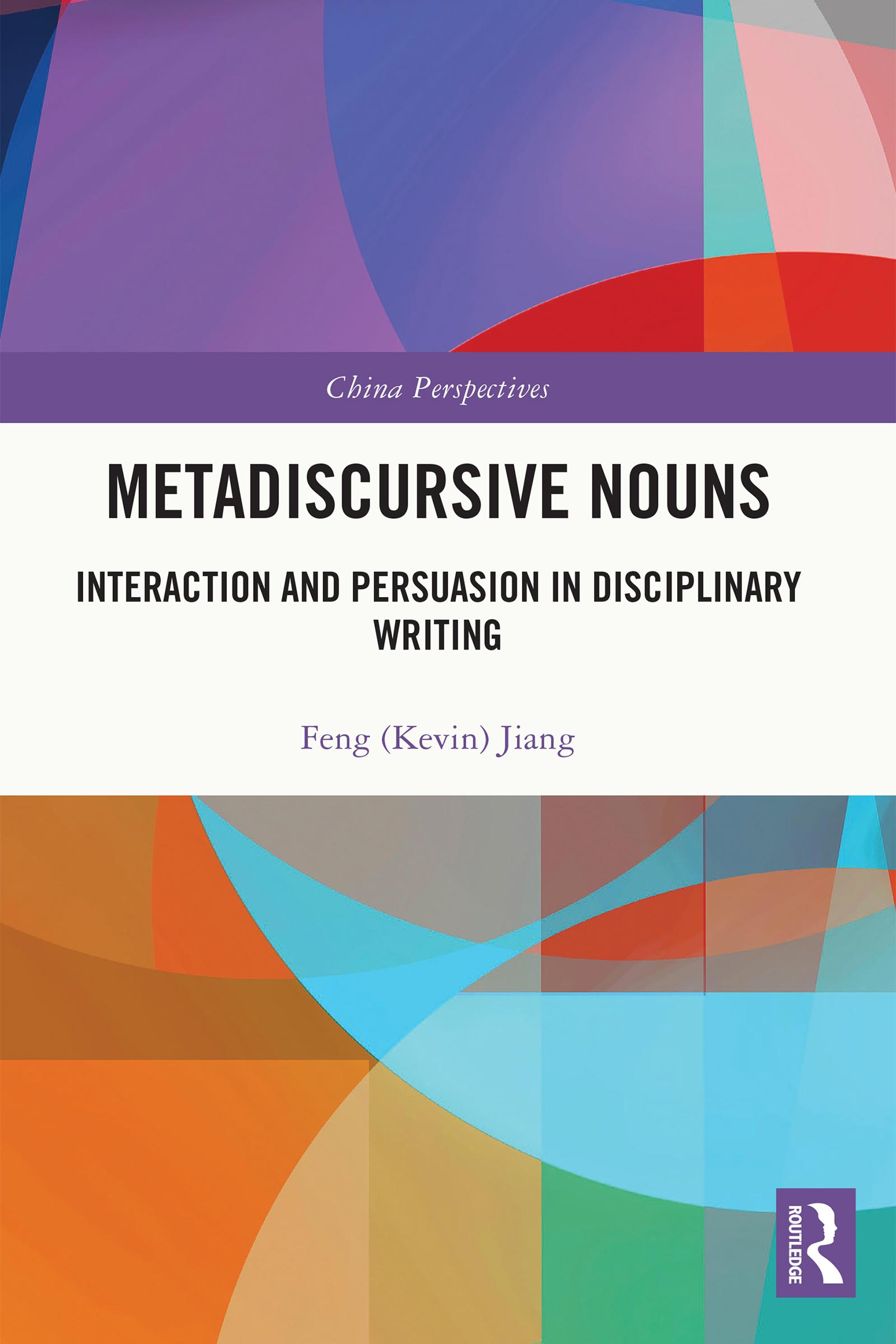
Based on a 1.7-million-word corpus of 160 research articles from both soft and hard knowledge fields, this book sets out to explore how a particular type of noun – namely, the metadiscursive noun – is rhetorically used to mediate writer-reader interaction in disciplinary writing.
Analysts of academic discourse have come to regard hedges, reporting verbs, directives and so on as forming part of a wide repertoire of interactive features available to authors, suggesting a variety of terms, including evaluation, stance, appraisal, and metadiscourse. One aspect which has been less fully explored, however, is the rhetorical role nouns play in achieving writers’ persuasive goals. This book fills the gap by proposing a particular type of nouns as metadiscursive nouns (as in “this supports our hypotheses that youth are more likely to co-offend when neighbourhoods are less disadvantaged”). The author aims to find out how writers employ metadiscursive nouns to engage and interact with readers in academic prose, raising theoretical and pedagogical implications and how they can be applied in the teaching of academic writing.
This book will be of particular interest to students and scholars working in the areas of English for academic purposes, corpus studies, academic writing, and linguistics in general.
Payez facilement par carte, Klarna, Apple Pay ou Google Pay. Pas satisfait ? Vous avez toujours une garantie de remboursement de 14 jours. En savoir plus dans nos conditions. Si vous avez des questions, envoyez-nous un e-mail à hello@memmo.org.
Memmo facilite tes études, où que tu sois dans le monde. On rassemble tes manuels de cours et des outils d'étude intelligents au même endroit : résumés, quiz, podcasts et flashcards. Et il y a Ted, ton compagnon d'étude qui répond à toutes tes questions. Plus de 50 000 étudiants étudient déjà ici – conçu pour t'aider à apprendre plus vite et à moins stresser.