
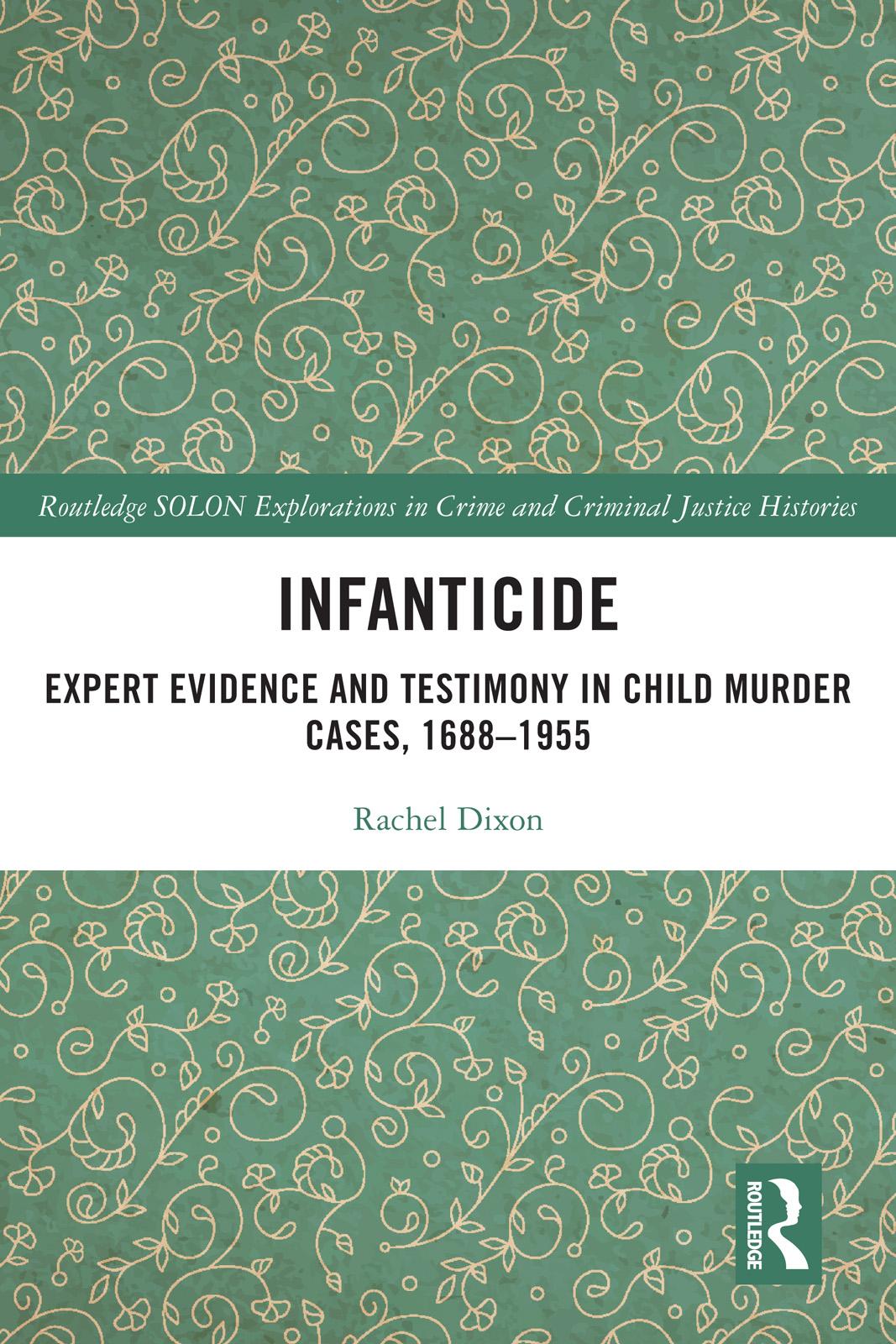
Infanticide examines medical expert evidence in infanticide cases, focusing specifically on the shifting notion of "certainty" in medical testimony. Beginning in the Early Modern period and concluding in the mid-twentieth century, it considers how courts determined whether an infant died from natural causes or other reasons, including violence.
The book explores expert evidence in cases of infanticide and examines the extent of certainty created by medical specialists who founded their testimony on anatomical exploration and science. As the book progresses, it becomes clear that medical specialists were unable to scientifically establish cause of death and in doing so conveyed uncertainty in court proceedings. Rather than being regarded as a professional failing, Dixon argues that the uncertainty created by medical specialists redirected the outcomes of infanticide cases. The combination of uncertainty and the changing perceptions of infanticidal women by the court lead juries to find infanticidal women not guilty of a capital offence in many cases.
This book will be of great interest to students and scholars of Criminology, Law and History.
Payez facilement par carte, Klarna, Apple Pay ou Google Pay. Pas satisfait ? Vous avez toujours une garantie de remboursement de 14 jours. En savoir plus dans nos conditions. Si vous avez des questions, envoyez-nous un e-mail à hello@memmo.org.
Memmo facilite tes études, où que tu sois dans le monde. On rassemble tes manuels de cours et des outils d'étude intelligents au même endroit : résumés, quiz, podcasts et flashcards. Et il y a Ted, ton compagnon d'étude qui répond à toutes tes questions. Plus de 50 000 étudiants étudient déjà ici – conçu pour t'aider à apprendre plus vite et à moins stresser.