
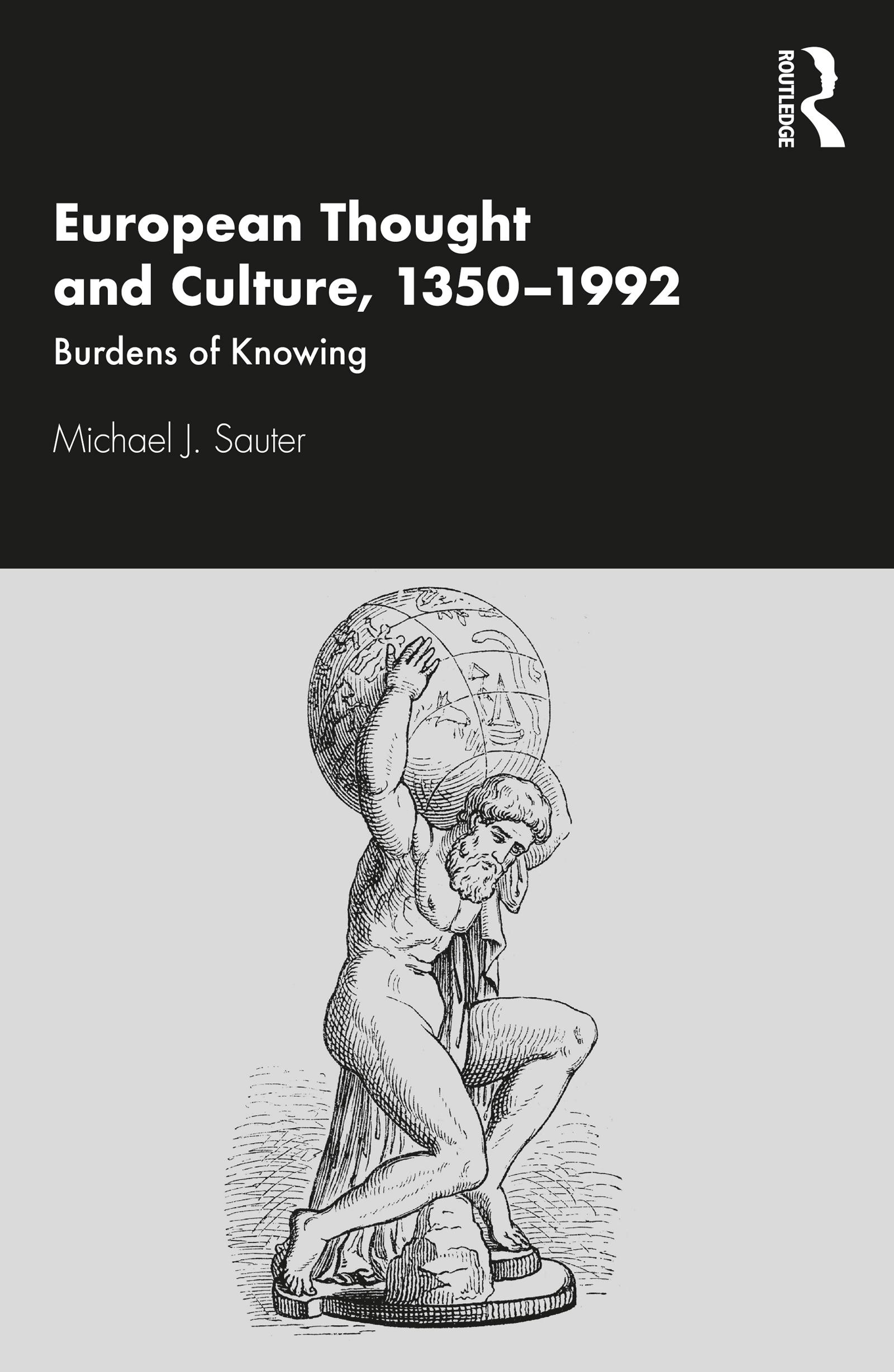
This book explores the main currents of European thought between 1350 and 1992, which it approaches in two principal ways: culture as produced by place and the progressive unmooring of thought from previously set religious and philosophical boundaries.
The book reads the period against spatial thought’s history (spatial sciences such as geography or Euclidean geometry) to argue that Europe cannot be understood as a continent in intellectual terms or its history organized with respect to traditional spatial-geographic categories. Instead we need to understand European intellectual history in terms of a culture that defined its own place, as opposed to a place that produced a given culture.
It then builds on this idea to argue that Europe’s overweening drive to know more about humanity and the cosmos continually breached the boundaries set by venerable religious and philosophical traditions. In this respect, spatial thought foregrounded the human at the unchanging’s expense, with European thought slowly becoming unmoored, as it doggedly produced knowledge at wisdom’s expense. Michael J. Sauter illustrates this by pursuing historical themes across different chapters, including European thought’s exit from the medieval period, the Renaissance, the Reformation, the Scientific Revolution, the Enlightenment and Romanticism, the Industrial Revolution, and war and culture, offering a thorough overview of European thought during this period. The book concludes by explaining how contemporary culture has forgotten what early modern thinkers such as Michel de Montaigne still knew, namely, that too little skepticism toward one’s own certainties makes one a danger to others.
Offering a comprehensive introduction to European thought that stretches from the late fourteenth to the late twentieth century, this is the perfect one-volume study for students of European intellectual history.
Payez facilement par carte, Klarna, Apple Pay ou Google Pay. Pas satisfait ? Vous avez toujours une garantie de remboursement de 14 jours. En savoir plus dans nos conditions. Si vous avez des questions, envoyez-nous un e-mail à hello@memmo.org.
Memmo facilite tes études, où que tu sois dans le monde. On rassemble tes manuels de cours et des outils d'étude intelligents au même endroit : résumés, quiz, podcasts et flashcards. Et il y a Ted, ton compagnon d'étude qui répond à toutes tes questions. Plus de 50 000 étudiants étudient déjà ici – conçu pour t'aider à apprendre plus vite et à moins stresser.