
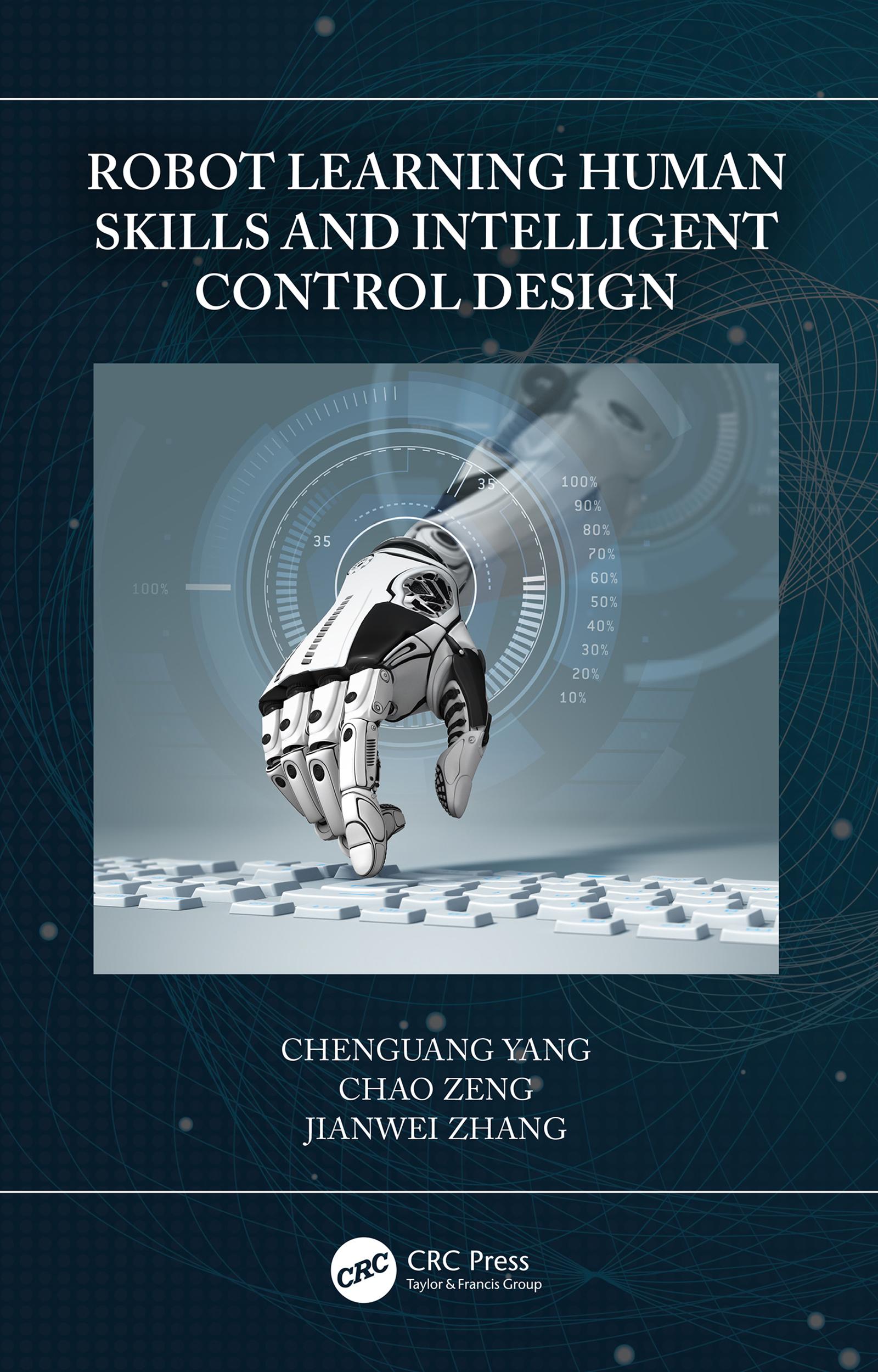
In the last decades robots are expected to be of increasing intelligence to deal with a large range of tasks. Especially, robots are supposed to be able to learn manipulation skills from humans. To this end, a number of learning algorithms and techniques have been developed and successfully implemented for various robotic tasks. Among these methods, learning from demonstrations (LfD) enables robots to effectively and efficiently acquire skills by learning from human demonstrators, such that a robot can be quickly programmed to perform a new task.
This book introduces recent results on the development of advanced LfD-based learning and control approaches to improve the robot dexterous manipulation. First, there's an introduction to the simulation tools and robot platforms used in the authors' research. In order to enable a robot learning of human-like adaptive skills, the book explains how to transfer a human user’s arm variable stiffness to the robot, based on the online estimation from the muscle electromyography (EMG). Next, the motion and impedance profiles can be both modelled by dynamical movement primitives such that both of them can be planned and generalized for new tasks. Furthermore, the book introduces how to learn the correlation between signals collected from demonstration, i.e., motion trajectory, stiffness profile estimated from EMG and interaction force, using statistical models such as hidden semi-Markov model and Gaussian Mixture Regression. Several widely used human-robot interaction interfaces (such as motion capture-based teleoperation) are presented, which allow a human user to interact with a robot and transfer movements to it in both simulation and real-word environments. Finally, improved performance of robot manipulation resulted from neural network enhanced control strategies is presented. A large number of examples of simulation and experiments of daily life tasks are included in this book to facilitate better understanding of the readers.
Payez facilement par carte, Klarna, Apple Pay ou Google Pay. Pas satisfait ? Vous avez toujours une garantie de remboursement de 14 jours. En savoir plus dans nos conditions. Si vous avez des questions, envoyez-nous un e-mail à hello@memmo.org.
Memmo facilite tes études, où que tu sois dans le monde. On rassemble tes manuels de cours et des outils d'étude intelligents au même endroit : résumés, quiz, podcasts et flashcards. Et il y a Ted, ton compagnon d'étude qui répond à toutes tes questions. Plus de 50 000 étudiants étudient déjà ici – conçu pour t'aider à apprendre plus vite et à moins stresser.