
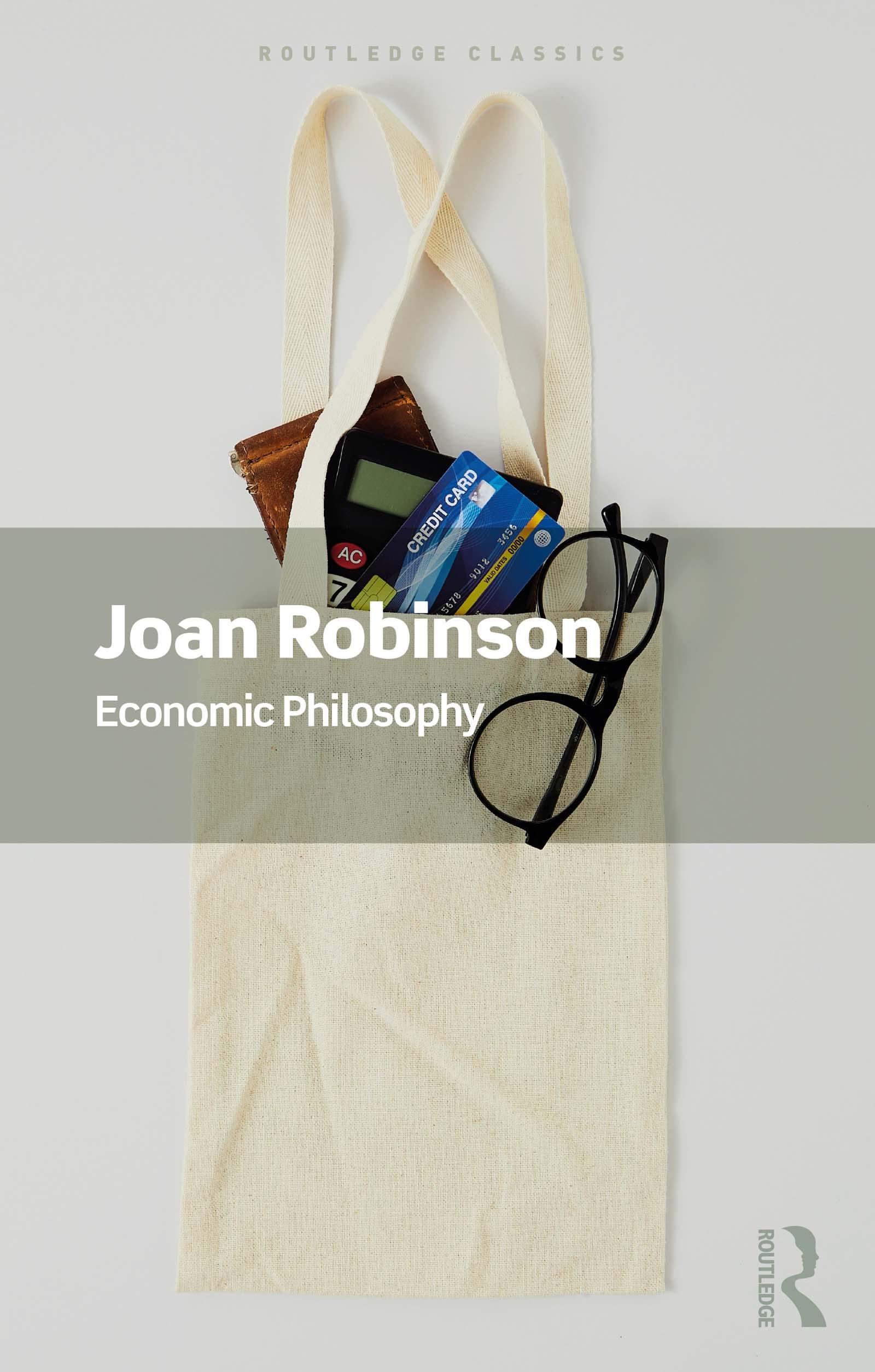
Joan Robinson (1903-1983) was one of the greatest economists of the twentieth century and a fearless critic of free-market capitalism. A major figure in the controversial ‘Cambridge School’ of economics in the post-war period, she made fundamental contributions to the economics of international trade and development.
In Economic Philosophy Robinson looks behind the curtain of economics to reveal a constant battle between economics as a science and economics as ideology, which she argued was integral to economics. In her customary vivid and pellucid style, she criticizes early economists Adam Smith and David Ricardo, and neo-classical economists Alfred Marshall, Stanley Jevons and Leon Walras, over the question of value. She shows that what they respectively considered to be the generators of value - labour-time, marginal utility or preferences - are not scientific but ‘metaphysical’, and that it is frequently in ideology, not science, that we find the reason for the rejection of economic theories. She also weighs up the implications of the Keynesian revolution in economics, particularly whether Keynes’s theories are applicable to developing economies. Robinson concludes with a prophetic lesson that resonates in today’s turbulent and unequal economy: that the task of the economist is to combat the idea that the only values that count are those that can be measured in terms of money.
This Routledge Classics edition includes a new foreword by Sheila Dow.
Payez facilement par carte, Klarna, Apple Pay ou Google Pay. Pas satisfait ? Vous avez toujours une garantie de remboursement de 14 jours. En savoir plus dans nos conditions. Si vous avez des questions, envoyez-nous un e-mail à hello@memmo.org.
Memmo facilite tes études, où que tu sois dans le monde. On rassemble tes manuels de cours et des outils d'étude intelligents au même endroit : résumés, quiz, podcasts et flashcards. Et il y a Ted, ton compagnon d'étude qui répond à toutes tes questions. Plus de 50 000 étudiants étudient déjà ici – conçu pour t'aider à apprendre plus vite et à moins stresser.