
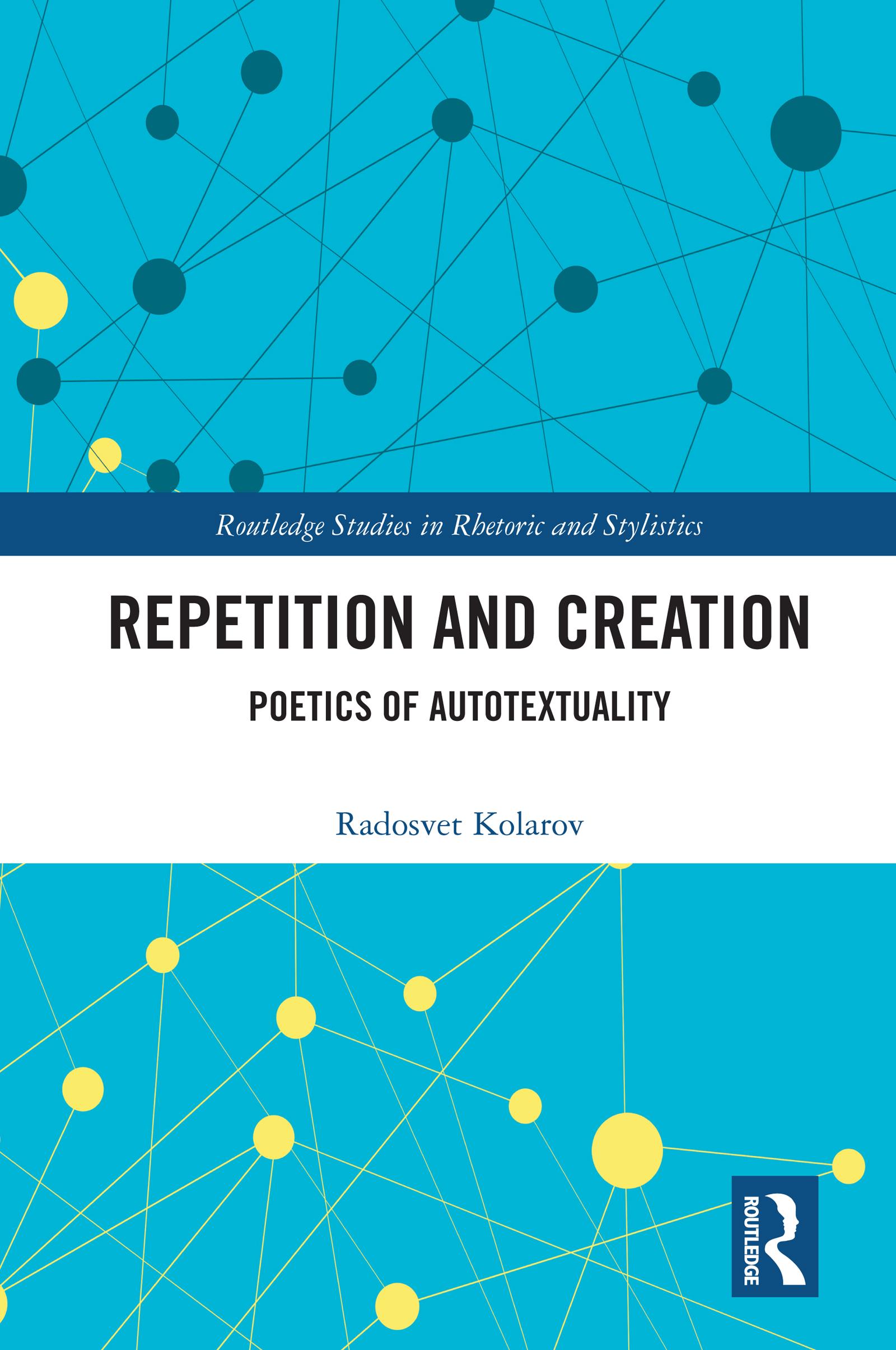
This book advances the notion of autotextuality, the dialogue between works in an author’s oeuvre, and the ways in which new texts are created in self-repetition through the tracing and revisiting of past texts and the subsequent uncovering of undisclosed meanings, unexhausted constructive principles, and alternative versions.
Kolarov draws on cognitive models, such as dual coding theory and conceptual blending, to substantiate a theory of autotextuality and build on previous work on self-repetition and difference to highlight the notion of “discursive desire,” in which new meanings are generated through repetition, and its distinct relationship to creativity. Drawing on analyses of well-established works in Bulgarian as well as the established oeuvres of such authors as Gogol, Dostoevsky, Kafka, and Baudelaire, the volume explores key themes in autotextuality such as the functions of creative memory, the connections between word and image, and the hermeneutic relationships and steps of transformation between texts.
This innovative work addresses topical questions of importance in literary theory today and will be of interest to students and scholars in literary studies and related areas of study within such fields as cognitive science, quantum mechanics, and psychology.
Payez facilement par carte, Klarna, Apple Pay ou Google Pay. Pas satisfait ? Vous avez toujours une garantie de remboursement de 14 jours. En savoir plus dans nos conditions. Si vous avez des questions, envoyez-nous un e-mail à hello@memmo.org.
Memmo facilite tes études, où que tu sois dans le monde. On rassemble tes manuels de cours et des outils d'étude intelligents au même endroit : résumés, quiz, podcasts et flashcards. Et il y a Ted, ton compagnon d'étude qui répond à toutes tes questions. Plus de 50 000 étudiants étudient déjà ici – conçu pour t'aider à apprendre plus vite et à moins stresser.