
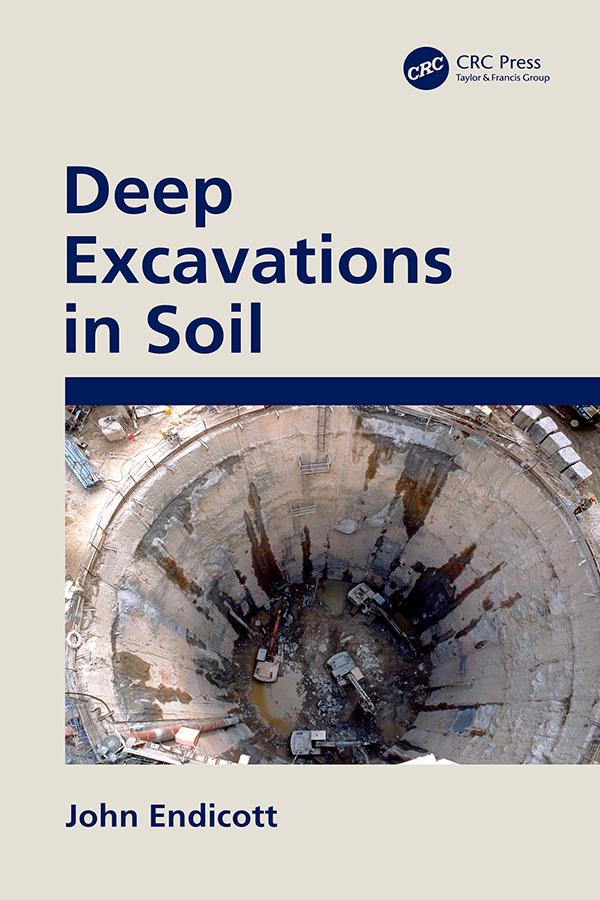
The book describes the theory and current practices for design of earth lateral support for deep excavations in soil. It addresses basic principles of soil mechanics and explains how these principles are embodied in design methods including hand calculations. It then introduces the use of numerical methods including the fundamental “beam on springs” models, and then more sophisticated computer programmes which can model soil as a continuum in two or three dimensions. Constitutive relationships are introduced that are in use for representing the behaviour of soil including a strain hardening model, and a Cam Clay model including groundwater flow and coupled consolidation.
These methods are illustrated by reference to practical applications and case histories from the author’s direct experience, and some of the pitfalls that can occur are discussed. Theory and design are strongly tied to construction practice, with emphasis on monitoring the retaining structures and movement of surrounding ground and structures, in the context of safety and the Observational Method. Examples are presented for conventional “Bottom-up” and “Top-down” sequences, along with hybrid sequences giving tips on how to optimise the design and effect economies of cost and time for construction. It is written for practising geotechnical, civil and structural engineers, and especially for senior and MSc students.
Payez facilement par carte, Klarna, Apple Pay ou Google Pay. Pas satisfait ? Vous avez toujours une garantie de remboursement de 14 jours. En savoir plus dans nos conditions. Si vous avez des questions, envoyez-nous un e-mail à hello@memmo.org.
Memmo facilite tes études, où que tu sois dans le monde. On rassemble tes manuels de cours et des outils d'étude intelligents au même endroit : résumés, quiz, podcasts et flashcards. Et il y a Ted, ton compagnon d'étude qui répond à toutes tes questions. Plus de 50 000 étudiants étudient déjà ici – conçu pour t'aider à apprendre plus vite et à moins stresser.