
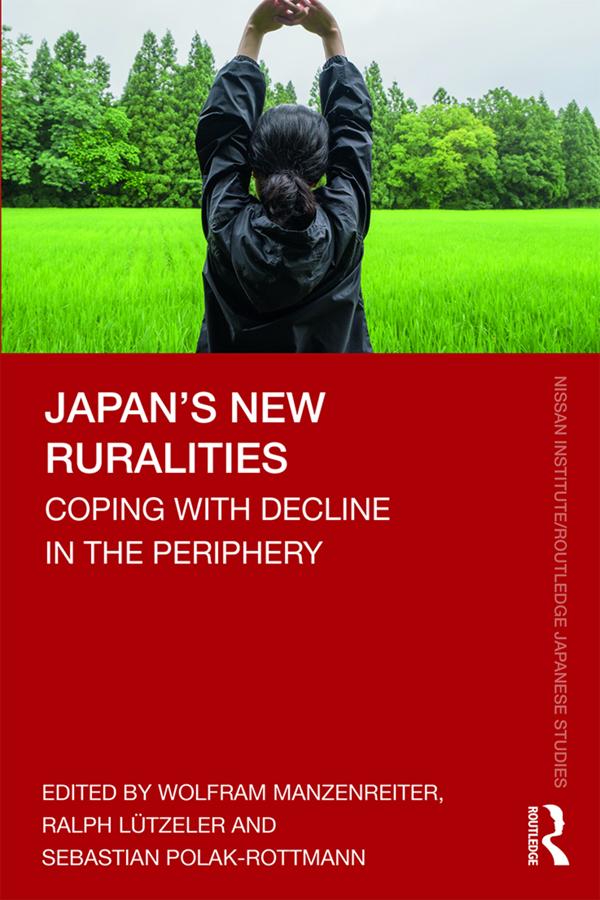
Seeking to challenge negative perceptions within Japanese media and politics on the future of the countryside, the contributors to this book present a counterargument to the inevitable demise of rural society.
Contrary to the dominant argument, which holds outmigration and demographic hyper-aging as primarily responsible for rural decline, this book highlights the spatial dimension of power differences behind uneven development in contemporary Japan. Including many fi eldwork-based case studies, the chapters discuss topics such as corporate farming, local energy systems and public healthcare, examining the constraints and possibilities of rural self-determination under the centripetal impact of forces located both in and outside of the country. Focusing on asymmetries of power to explore regional autonomy and heteronomy, it also examines "peripheralization" and the "global countryside," two recent theoretical contributions to the fi eld, as a common framework.
Japan’s New Ruralities addresses the complexity of rural decline in the context of debates on globalization and power differences. As such, it will be of interest to students and scholars of sociology, anthropology, human geography and politics, as well as Japanese Studies.
Payez facilement par carte, Klarna, Apple Pay ou Google Pay. Pas satisfait ? Vous avez toujours une garantie de remboursement de 14 jours. En savoir plus dans nos conditions. Si vous avez des questions, envoyez-nous un e-mail à hello@memmo.org.
Memmo facilite tes études, où que tu sois dans le monde. On rassemble tes manuels de cours et des outils d'étude intelligents au même endroit : résumés, quiz, podcasts et flashcards. Et il y a Ted, ton compagnon d'étude qui répond à toutes tes questions. Plus de 50 000 étudiants étudient déjà ici – conçu pour t'aider à apprendre plus vite et à moins stresser.