
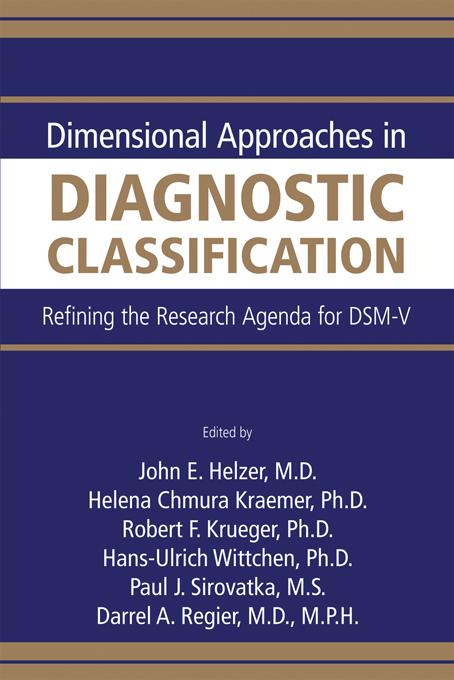
Since its initial publication more than 50 years ago, the DSM has systematized the complex intellectual and clinical process of diagnosing mentally ill persons through the use of categories and classification. The manuals have provided a consistent diagnostic language for clinical work, research, and teaching; have established a common international taxonomic standard; and have provided psychiatrists with a means of communicating with patients and the public. With a new iteration of the DSM on the horizon, the APA has initiated a multiphase research review process designed to set the stage for the fifth revision, due to be published in 2013.
This book brings together the most promising research presented at the conference "The Future of Psychiatric Diagnosis: Refining the Research Agenda," which was convened by the APA, in collaboration with the World Health Organization and the U.S. National Institutes of Health. Conferees were challenged to go beyond the current categorical definitions set forth in DSM-III and DSM-IV and suggest ways of incorporating more quantitative, dimensional concepts into DSM-V. The resulting work: Addresses the challenge of creating dimensional measures that are compatible with existing categorical definitions and do not unduly disrupt clinical practice Applies a dimensional approach to a broad range of diagnoses, including substance dependence, major depressive episode, psychosis, anxiety disorders, developmental psychopathology, and personality disorders Facilitates the development of broadly agreed upon criteria that researchers worldwide can use in planning and conducting future research exploring the etiology and pathophysiology of mental disorders Identifies and encourages the empirical research necessary to allow informed decision making regarding deficiencies acknowledged in DSM-IV Promotes international collaboration with the objective of eliminating the remaining disparities between DSM-V and the International Classification of Diseases Mental and Behavioural Disorders Section, the next edition of which is due to be released in 2014.
The book's painstaking scholarship and thoughtful conclusions should stimulate interest in finding new ways of combining categorical and dimensional approaches in psychiatric nosology. Clinicians and researchers in the United States and the international psychiatric community will discover, in these pages, the beginnings of a new, quantitative methodology that represents the next stage in the evolution of DSM.
Payez facilement par carte, Klarna, Apple Pay ou Google Pay. Pas satisfait ? Vous avez toujours une garantie de remboursement de 14 jours. En savoir plus dans nos conditions. Si vous avez des questions, envoyez-nous un e-mail à hello@memmo.org.
Memmo facilite tes études, où que tu sois dans le monde. On rassemble tes manuels de cours et des outils d'étude intelligents au même endroit : résumés, quiz, podcasts et flashcards. Et il y a Ted, ton compagnon d'étude qui répond à toutes tes questions. Plus de 50 000 étudiants étudient déjà ici – conçu pour t'aider à apprendre plus vite et à moins stresser.