
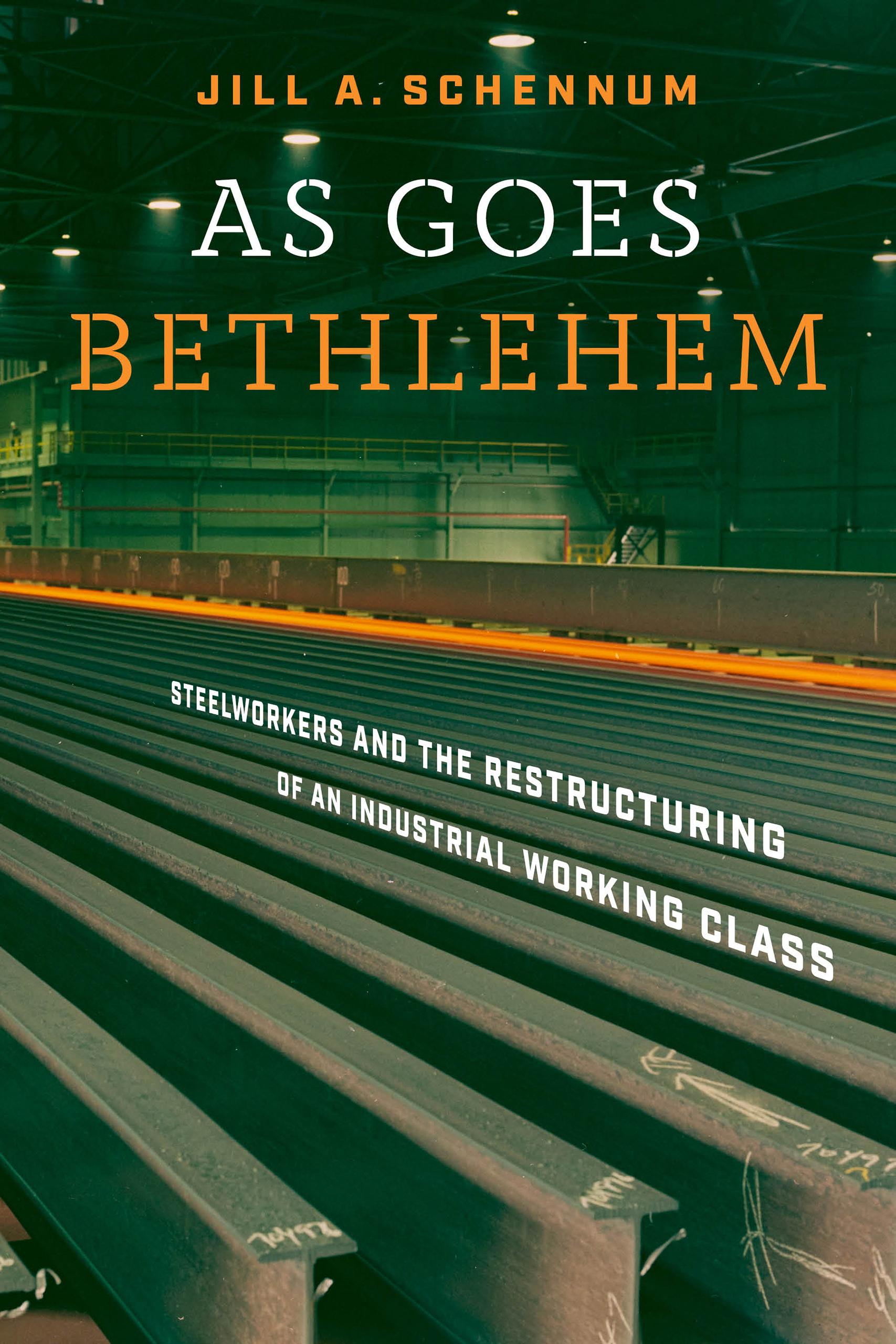
The steel industry played a central role in building post–World War II economic success in the US and in defining the parameters of the post–World War II social contract. As these long-term processes both preceded and contributed to the Great Recession, a new capitalism—one in which banks and the credit system took precedence over industrial production—changed the lives of many American workers, including steelworkers. As Goes Bethlehem raises important questions about why workers and their unions were not able to successfully contest this attack on industrial labor, instead settling for best navigating a long downward trajectory.
Through the experiences and reflections of steelworkers, Jill A. Schennum demonstrates the significance of work, and particularly of industrial work, in giving meaning to people’s lives, identities, and sense of worth. She uses workers’ narratives and voices to show the importance of work space, time, and social relations, rejecting dominant interpretations of blue-collar workers as alienated from their work but well-paid and co-opted by a middle-class standard of living. Schennum covers thirty-five years of investment and disinvestment, managerial initiatives, transfer decisions, layoffs and downsizings, external transfers, the eventual bankruptcy of the Bethlehem Steel Corporation, and movement into retirement, unemployment, and new postindustrial jobs.
The very solidarities, rights of citizenship, and rule of law forged in the mill and built on by the union were constructed, in part, through exclusions based on race, ethnicity, gender, and region. These lines of fracture were mobilized to undermine working-class strength in the postindustrial period. Through the experiences of African American, Puerto Rican, coal country, and women workers in the steel mills, this book explores these issues of fracture and solidarity.
Through the experiences and reflections of steelworkers, Jill A. Schennum demonstrates the significance of work, and particularly of industrial work, in giving meaning to people’s lives, identities, and sense of worth. She uses workers’ narratives and voices to show the importance of work space, time, and social relations, rejecting dominant interpretations of blue-collar workers as alienated from their work but well-paid and co-opted by a middle-class standard of living. Schennum covers thirty-five years of investment and disinvestment, managerial initiatives, transfer decisions, layoffs and downsizings, external transfers, the eventual bankruptcy of the Bethlehem Steel Corporation, and movement into retirement, unemployment, and new postindustrial jobs.
The very solidarities, rights of citizenship, and rule of law forged in the mill and built on by the union were constructed, in part, through exclusions based on race, ethnicity, gender, and region. These lines of fracture were mobilized to undermine working-class strength in the postindustrial period. Through the experiences of African American, Puerto Rican, coal country, and women workers in the steel mills, this book explores these issues of fracture and solidarity.
Pages: 306
Catégorie: Sociologi
e-ISBN: 9780826505903
Poids d'expédition: 1.2 kg
Expédié sous: 1-2 jours
Payez facilement par carte, Klarna, Apple Pay ou Google Pay. Pas satisfait ? Vous avez toujours une garantie de remboursement de 14 jours. En savoir plus dans nos conditions. Si vous avez des questions, envoyez-nous un e-mail à hello@memmo.org.
Memmo facilite tes études, où que tu sois dans le monde. On rassemble tes manuels de cours et des outils d'étude intelligents au même endroit : résumés, quiz, podcasts et flashcards. Et il y a Ted, ton compagnon d'étude qui répond à toutes tes questions. Plus de 50 000 étudiants étudient déjà ici – conçu pour t'aider à apprendre plus vite et à moins stresser.
Tu pourrais aussi aimer
Acheter le livre0