
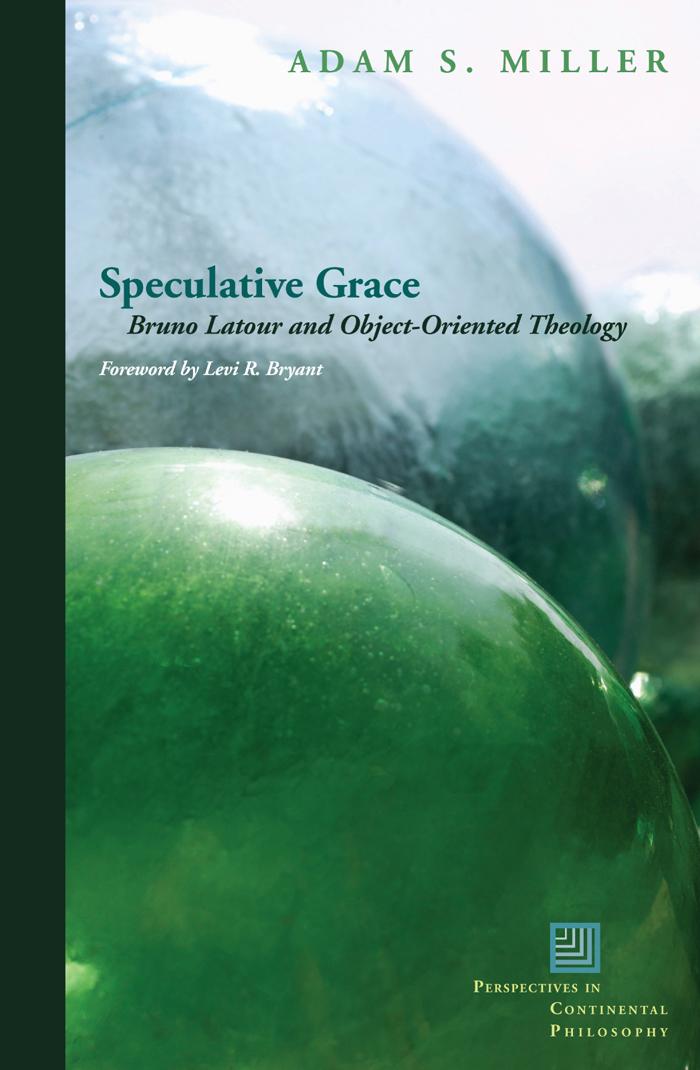
This book offers a novel account of grace framed in terms of Bruno Latour’s “principle of irreduction.” It thus models an object-oriented approach to grace, experimentally moving a traditional Christian understanding of grace out of a top-down, theistic ontology and into an agent-based, object-oriented ontology. In the process, it also provides a systematic and original account of Latour’s overall project.
The account of grace offered here redistributes the tasks assigned to science and religion. Where now the work of science is to bring into focus objects that are too distant, too resistant, and too transcendent to be visible, the business of religion is to bring into focus objects that are too near, too available, and too immanent to be visible. Where science reveals transcendent objects by correcting for our nearsightedness, religion reveals immanent objects by correcting for our farsightedness. Speculative Grace remaps the meaning of grace and examines the kinds of religious instruments and practices that, as a result, take center stage.
Payez facilement par carte, Klarna, Apple Pay ou Google Pay. Pas satisfait ? Vous avez toujours une garantie de remboursement de 14 jours. En savoir plus dans nos conditions. Si vous avez des questions, envoyez-nous un e-mail à hello@memmo.org.
Memmo facilite tes études, où que tu sois dans le monde. On rassemble tes manuels de cours et des outils d'étude intelligents au même endroit : résumés, quiz, podcasts et flashcards. Et il y a Ted, ton compagnon d'étude qui répond à toutes tes questions. Plus de 50 000 étudiants étudient déjà ici – conçu pour t'aider à apprendre plus vite et à moins stresser.