
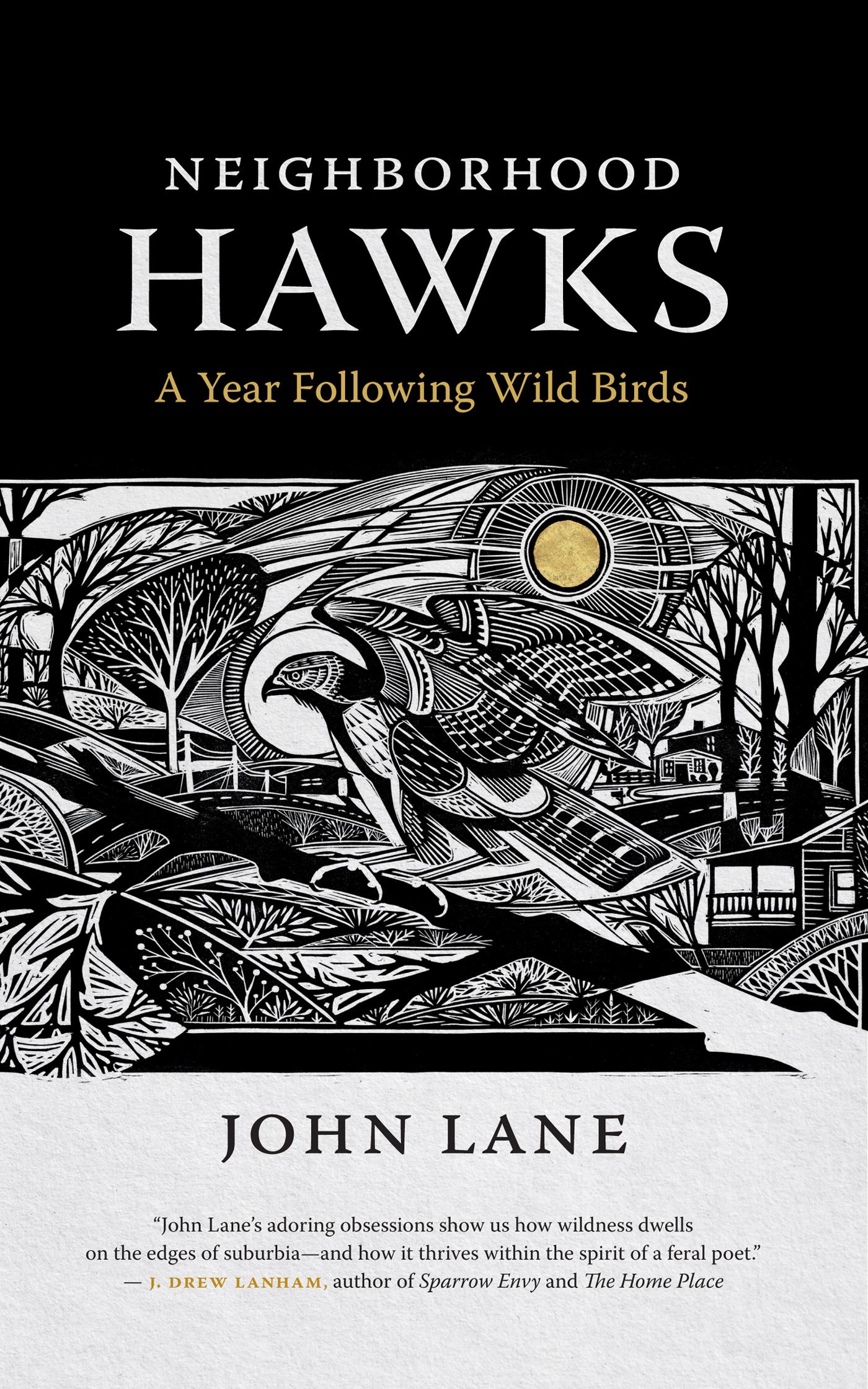
After reading J. A. Baker’s fifty-year-old British nature classic The Peregrine, John Lane found himself an ocean away, stalking resident red-shouldered hawks in his neighborhood in Spartanburg, South Carolina. What he observed was very different from what Baker deduced from a decade of chronicling the lives of those brooding migratory raptors. Baker imagined a species on the brink of extinction because of the use of agricultural chemicals on European farms. A half century later in America, Lane found the red-shouldered hawks to be a stable Anthropocene species adapted to life along the waterways of a suburban nation.
Lane watched the hawks for a full year and along the way made a pledge to himself: Anytime he heard or saw the noisy, nonmigratory hawks in his neighborhood, he would drop whatever he was doing and follow them on foot, on bike, or in his truck. The almanac that results from this discipline considers many questions any practiced amateur naturalist would ask, such as where and when will the hawks nest, what do they eat, what are their greatest threats, and what exactly are they communicating through those constant multinoted cries? Lane’s year following the hawks also led him to try to answer what would become the most complex question of all: why his heart, like Baker’s, goes out so fully to wild things.
Payez facilement par carte, Klarna, Apple Pay ou Google Pay. Pas satisfait ? Vous avez toujours une garantie de remboursement de 14 jours. En savoir plus dans nos conditions. Si vous avez des questions, envoyez-nous un e-mail à hello@memmo.org.
Memmo facilite tes études, où que tu sois dans le monde. On rassemble tes manuels de cours et des outils d'étude intelligents au même endroit : résumés, quiz, podcasts et flashcards. Et il y a Ted, ton compagnon d'étude qui répond à toutes tes questions. Plus de 50 000 étudiants étudient déjà ici – conçu pour t'aider à apprendre plus vite et à moins stresser.