
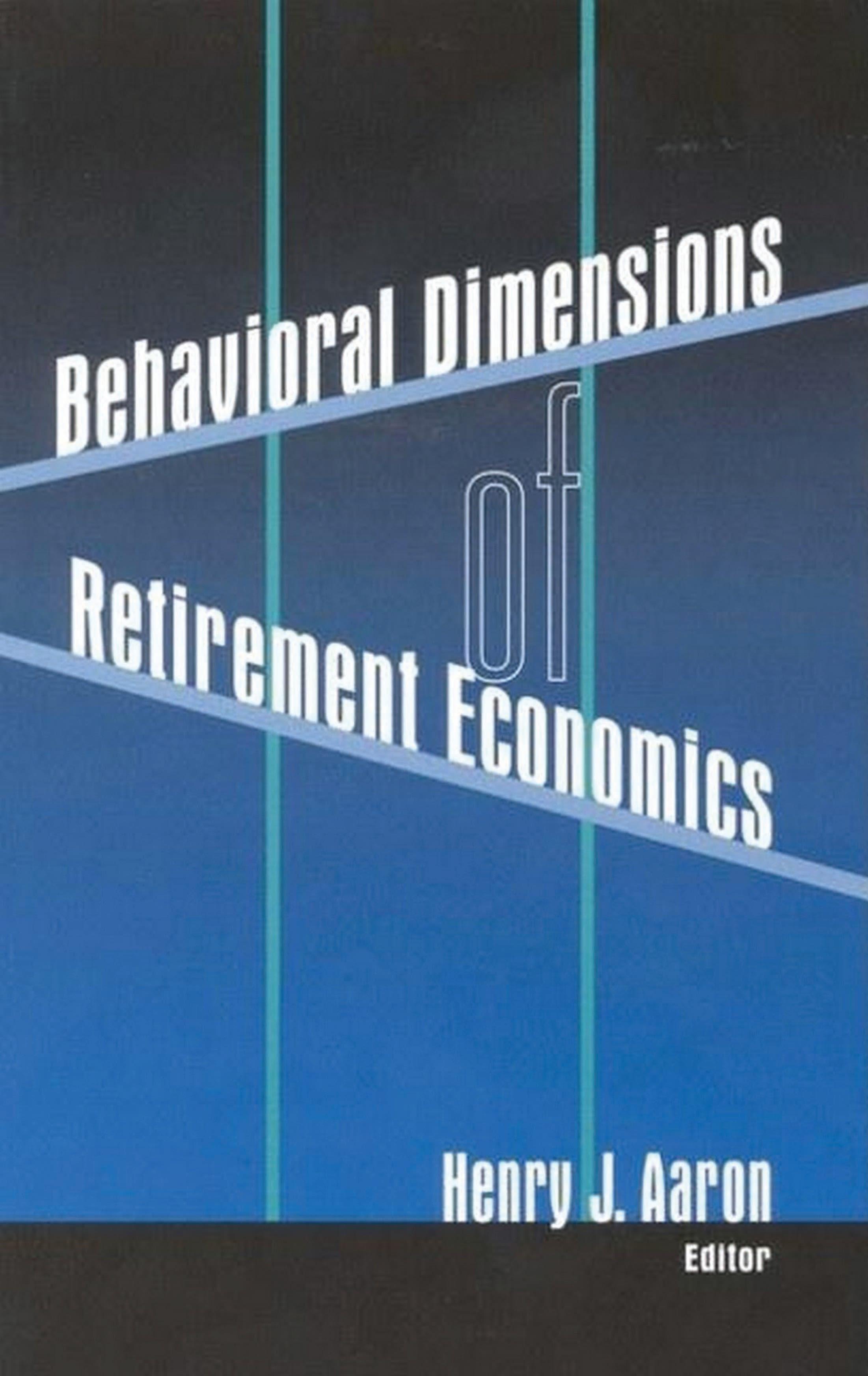
Deciding when and how to retire are among the most important decisions most people make. Can they be depended on to plan with foresight and make sound decisions? According to standard economic analysis the answer is a qualified "yes." But studies by psychologists, sociologists, and economists themselves raise doubts about this comforting appraisal.
This volume by analysts trained in economics and other disciplines suggests that retirement planning and decisions fall far short of the rational ideal. Gary Burtless explains what economic research has to say about retirement behavior. Annamaria Lusardi reports that many people in their fifties and older say they have not even thought about retirement. Mathey Rabin and Ted O'Donoghue show that procrastination can cause huge economic losses. Robert Axtell and Joshua Epstein show that herd behavior explains observed patterns of retirement behavior better than does the assumption of rational decision making. George Loewenstein, Drazen Prelec, and Roberto Weber report that many people incorrectly anticipate what retirement will be like and rationalize whatever decision they have made. David Fetherstonhaugh and Lee Ross report experimental evidence that the effect of Social Security provisions may depend on how these policies are ""framed"" as well as on the specific content of those policies. These and other authors also explore the broader implications of these behavioral patterns. Copublished with Russell Sage Foundation
This volume by analysts trained in economics and other disciplines suggests that retirement planning and decisions fall far short of the rational ideal. Gary Burtless explains what economic research has to say about retirement behavior. Annamaria Lusardi reports that many people in their fifties and older say they have not even thought about retirement. Mathey Rabin and Ted O'Donoghue show that procrastination can cause huge economic losses. Robert Axtell and Joshua Epstein show that herd behavior explains observed patterns of retirement behavior better than does the assumption of rational decision making. George Loewenstein, Drazen Prelec, and Roberto Weber report that many people incorrectly anticipate what retirement will be like and rationalize whatever decision they have made. David Fetherstonhaugh and Lee Ross report experimental evidence that the effect of Social Security provisions may depend on how these policies are ""framed"" as well as on the specific content of those policies. These and other authors also explore the broader implications of these behavioral patterns. Copublished with Russell Sage Foundation
Payez facilement par carte, Klarna, Apple Pay ou Google Pay. Pas satisfait ? Vous avez toujours une garantie de remboursement de 14 jours. En savoir plus dans nos conditions. Si vous avez des questions, envoyez-nous un e-mail à hello@memmo.org.
Memmo facilite tes études, où que tu sois dans le monde. On rassemble tes manuels de cours et des outils d'étude intelligents au même endroit : résumés, quiz, podcasts et flashcards. Et il y a Ted, ton compagnon d'étude qui répond à toutes tes questions. Plus de 50 000 étudiants étudient déjà ici – conçu pour t'aider à apprendre plus vite et à moins stresser.