
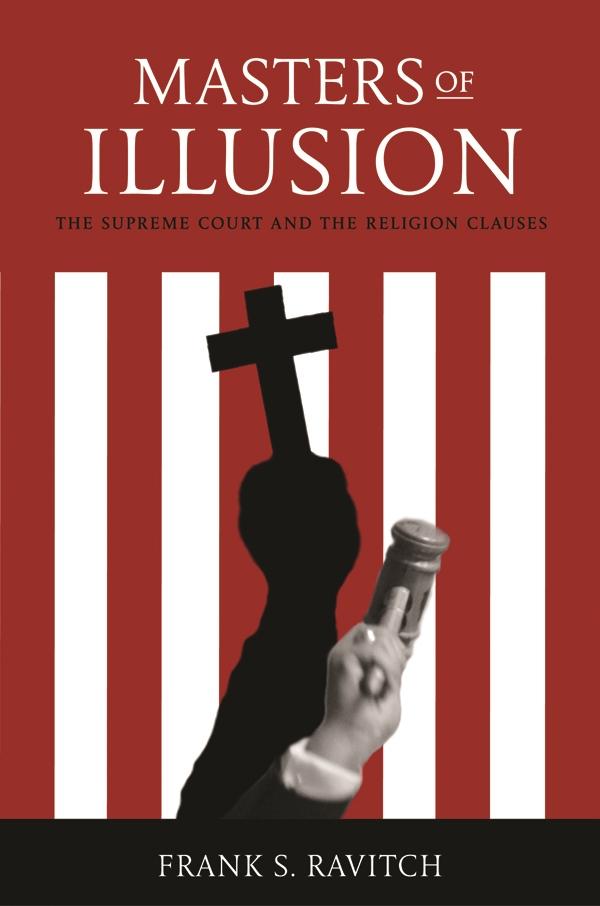
Many legal theorists and judges agree on one major premise in the field of law and religion: that religion clause jurisprudence is in a state of disarray and has been for some time. In Masters of Illusion, Frank S. Ravitch provocatively contends that both hard originalism (a strict focus on the intent of the Framers) and neutrality are illusory in religion clause jurisprudence, the former because it cannot live up to its promise for either side in the debate and the latter because it is simply impossible in the religion clause context. Yet these two principles have been used in almost every Supreme Court decision addressing religion clause questions.
Ravitch unpacks the various principles of religion clause interpretation, drawing on contemporary debates such as school prayer and displaying the Ten Commandments on courthouses, to demonstrate that the neutrality principle does not work in a pluralistic society. When defined by large, overarching principles of equality and liberty, neutrality fails to account for differences between groups and individuals. If, however, the Court drew on a variety of principles instead of a single notion of neutrality to decide whether or not laws facilitated or discouraged religious practices, the result could be a more equitable approach to religion clause cases.
Payez facilement par carte, Klarna, Apple Pay ou Google Pay. Pas satisfait ? Vous avez toujours une garantie de remboursement de 14 jours. En savoir plus dans nos conditions. Si vous avez des questions, envoyez-nous un e-mail à hello@memmo.org.
Memmo facilite tes études, où que tu sois dans le monde. On rassemble tes manuels de cours et des outils d'étude intelligents au même endroit : résumés, quiz, podcasts et flashcards. Et il y a Ted, ton compagnon d'étude qui répond à toutes tes questions. Plus de 50 000 étudiants étudient déjà ici – conçu pour t'aider à apprendre plus vite et à moins stresser.