
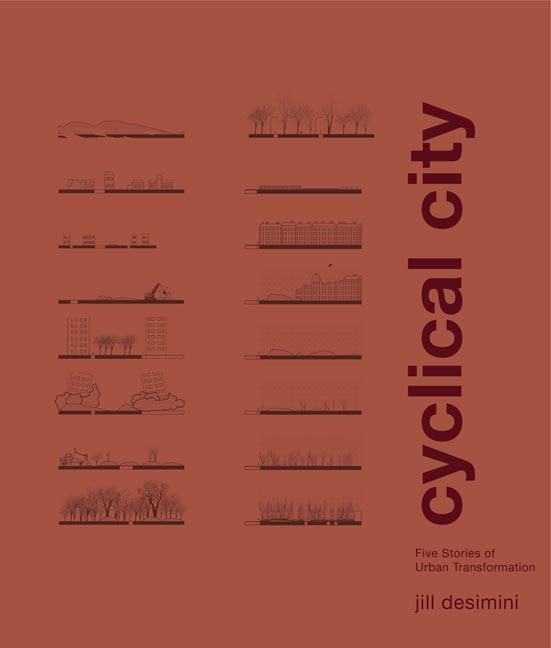
As cities evolve and resources shift with time, spaces within those cities are often left fallow and abandoned. Cyclical City tells the stories behind these sites, from Philadelphia’s Liberty Lands park to Lisbon’s Green Plan, and it looks at the ways in which these narratives can be leveraged toward future engagement and use. Jill Desimini posits a fundamental role for spatial design practice to transform abandoned urban landscapes through time. She argues for approaches that promote the specific affordances of the land itself (hydrology, vegetation, topography, geology, infrastructural capacity, occupation potential); the importance of cyclical change; and the particularities of the cultural, political, and physical context. These themes are explored in five cities—Philadelphia, Berlin, Lisbon, Amsterdam, and Saint Louis—and across centuries, from periods of great upheaval to ones of relative stability and even economic growth. Desimini considers what landscape-driven design can bring to cities losing people and economic resources, how design practice can be more inclusive in a context of market failure, and the ways in which abandoned landscapes can become our commons.
Preparation of this volume has been supported by Furthermore: a program of the J. M. Kaplan Fund
Payez facilement par carte, Klarna, Apple Pay ou Google Pay. Pas satisfait ? Vous avez toujours une garantie de remboursement de 14 jours. En savoir plus dans nos conditions. Si vous avez des questions, envoyez-nous un e-mail à hello@memmo.org.
Memmo facilite tes études, où que tu sois dans le monde. On rassemble tes manuels de cours et des outils d'étude intelligents au même endroit : résumés, quiz, podcasts et flashcards. Et il y a Ted, ton compagnon d'étude qui répond à toutes tes questions. Plus de 50 000 étudiants étudient déjà ici – conçu pour t'aider à apprendre plus vite et à moins stresser.