
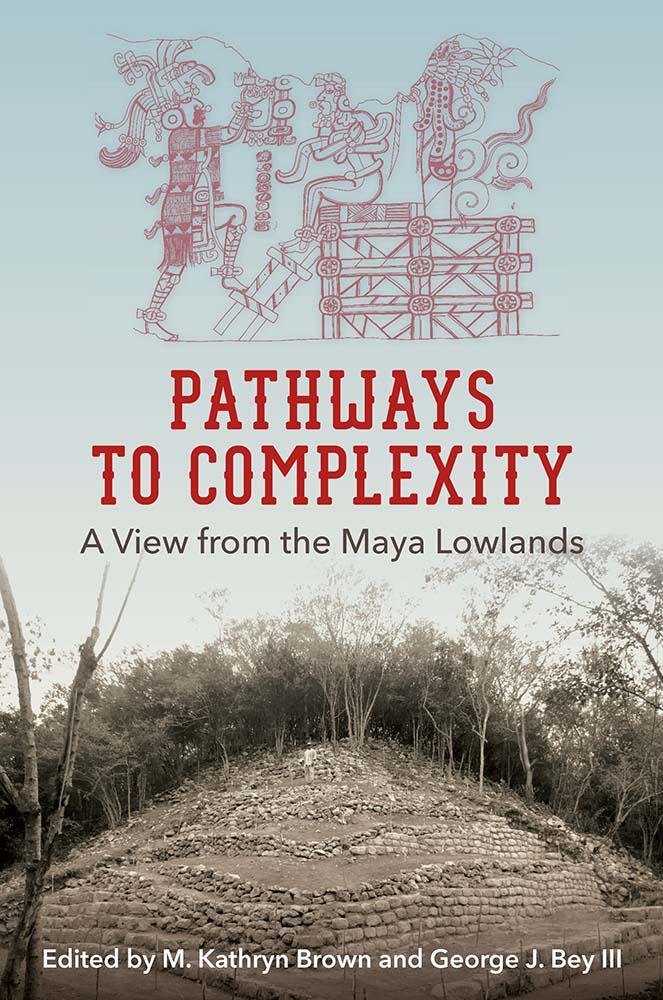
Pathways to Complexity synthesizes a wealth of new archaeological data to illuminate the origins of Maya civilization and the rise of Classic Maya culture. In this volume, prominent Maya scholars argue that the development of social, religious, and economic complexity began during the Middle Preclassic period (1000–300 B.C.), hundreds of years earlier than previously thought.
Contributors reveal that villages were present in parts of the lowlands by 1000 B.C., challenging the prevailing models estimating when civilization took root in the area. Combining recent discoveries from the northern lowlands—an area often neglected in other volumes—and the southern lowlands, the collection then traces the emergence of sociopolitical inequality and complexity in all parts of the Yucatan peninsula over the course of the Middle Preclassic period. They show that communities evolved in different ways due to influences such as geographical location, ceramic exchange, shell ornament production, agricultural strategy, religious ritual, ideology, and social rankings. These varied pathways to complexity developed over half a millennium and culminated in the institution of kingship by the Late Preclassic period.
Presenting exciting work on a dynamic and poorly understood time period, Pathways to Complexity demonstrates the importance of a broad, comparative approach to understanding Preclassic Maya civilization and will serve as a foundation for future research and interpretation.
Contributors: M. Kathryn Brown | Dr. George Bey III | Tara Bond-Freeman | Fernando Robles Castellanos | Tomas Gallareta Negron | E. Wyllys Andrews V | Anthony Andrews | David S. Anderson | Lauren Sullivan | Jaime J. Awe | James F. Garber | Mary Jane Acuña | William Saturno | Bobbi Hohmann | Terry Powis | Paul Healy | Richard Hansen | Donald W. Forsyth | David Freidel | Barbara Arroyo | Richard E. W. Adams
A volume in the series Maya Studies, edited by Diane Z. Chase and Arlen F. Chase
Payez facilement par carte, Klarna, Apple Pay ou Google Pay. Pas satisfait ? Vous avez toujours une garantie de remboursement de 14 jours. En savoir plus dans nos conditions. Si vous avez des questions, envoyez-nous un e-mail à hello@memmo.org.
Memmo facilite tes études, où que tu sois dans le monde. On rassemble tes manuels de cours et des outils d'étude intelligents au même endroit : résumés, quiz, podcasts et flashcards. Et il y a Ted, ton compagnon d'étude qui répond à toutes tes questions. Plus de 50 000 étudiants étudient déjà ici – conçu pour t'aider à apprendre plus vite et à moins stresser.