
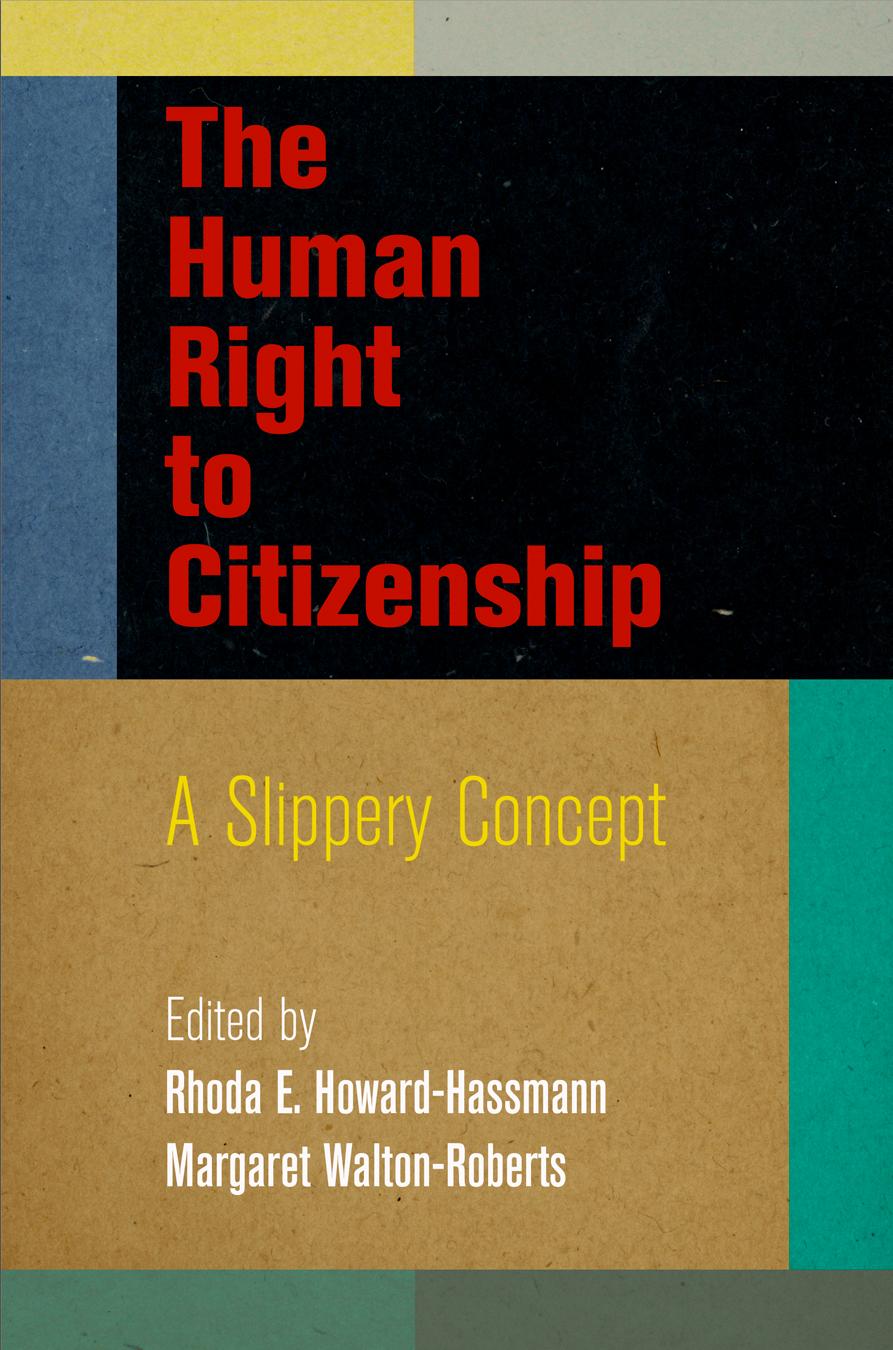
In principle, no human individual should be rendered stateless: the Universal Declaration of Human Rights stipulates that the right to have or change citizenship cannot be denied. In practice, the legal claim of citizenship is a slippery concept that can be manipulated to serve state interests. On a spectrum from those who enjoy the legal and social benefits of citizenship to those whose right to nationality is outright refused, people with many kinds of status live in various degrees of precariousness within states that cannot or will not protect them. These include documented and undocumented migrants as well as conventional refugees and asylum seekers living in various degrees of uncertainty. Vulnerable populations such as ethnic minorities and women and children may find that de jure citizenship rights are undermined by de facto restrictions on their access, mobility, or security.
The Human Right to Citizenship provides an accessible overview of citizenship regimes around the globe, focusing on empirical cases of denied or weakened legal rights. Exploring the legal and social implications of specific national contexts, contributors examine the status of labor migrants in the United States and Canada, the changing definition of citizenship in Nigeria, Germany, India, and Brazil, and the rights of ethnic groups including Palestinians, Rohingya refugees in Bangladesh, Bangladeshi migrants to India, and Roma in Europe. Other chapters consider children's rights to citizenship, multiple citizenships, and unwanted citizenships. With a broad geographical scope, this volume provides a wide-ranging theoretical and legal framework to understand the particular ambiguities, paradoxes, and evolutions of citizenship regimes in the twenty-first century.
Contributors: Michal Baer, Kristy A. Belton, Jacqueline Bhabha, Thomas Faist, Jenna Hennebry, Nancy Hiemstra, Rhoda E. Howard-Hassmann, Audrey Macklin, Margareta Matache, Janet McLaughlin, Carolina Moulin, Alison Mountz, Helen O'Nions, Chidi Anselm Odinkalu, Sujata Ramachandran, Kim Rygiel, Nasir Uddin, Margaret Walton-Roberts, David S. Weissbrodt.
Payez facilement par carte, Klarna, Apple Pay ou Google Pay. Pas satisfait ? Vous avez toujours une garantie de remboursement de 14 jours. En savoir plus dans nos conditions. Si vous avez des questions, envoyez-nous un e-mail à hello@memmo.org.
Memmo facilite tes études, où que tu sois dans le monde. On rassemble tes manuels de cours et des outils d'étude intelligents au même endroit : résumés, quiz, podcasts et flashcards. Et il y a Ted, ton compagnon d'étude qui répond à toutes tes questions. Plus de 50 000 étudiants étudient déjà ici – conçu pour t'aider à apprendre plus vite et à moins stresser.