
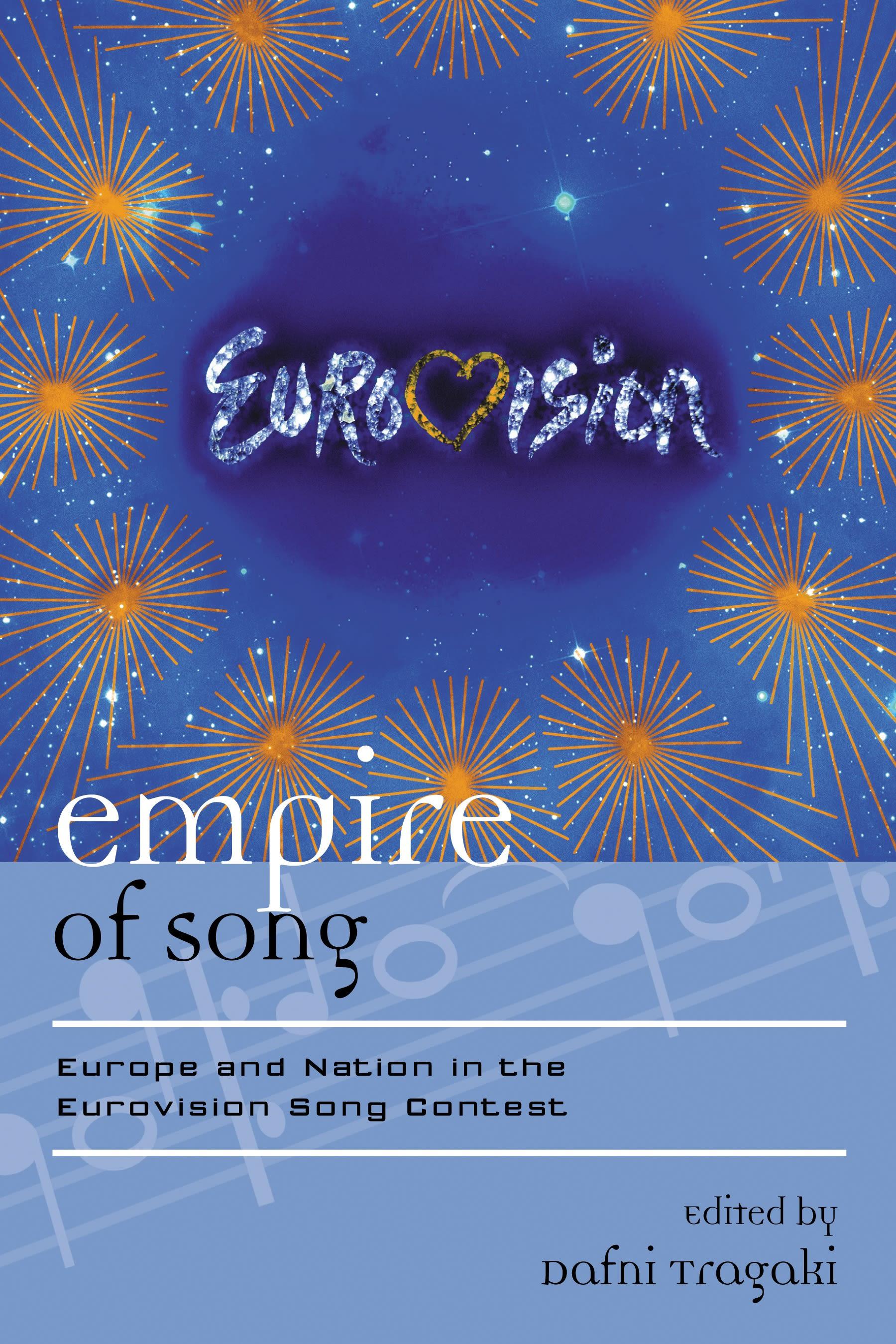
The Eurovision Song Contest (ESC) is more than a musical event that ostensibly “unites European people” through music. It is a spectacle: a performative event that allegorically represents the idea of “Europe.” Since its beginning in the Cold War era, the contest has functioned as a symbolic realm for the performance of European selves and the negotiation of European identities. Through the ESC, Europe is experienced, felt, and imagined in singing and dancing as the interplay of tropes of being local and/or European is enacted.
In Empire of Song: Europe and Nation in the Eurovision Song Contest, contributors interpret the ESC as a musical “mediascape” and mega-event that has variously performed and performs the changing visions of the European project. Through the study of the cultural politics of the ESC, contributors discuss the ways in which music operates as a dynamic nexus for making national identities and European sensibilities, generating processes of “assimilation” or “integration,” and defining the celebrated notion of the “European citizen” in a global context. Scholars in the volume also explore the ways otherness and difference are produced, spectacularized, challenged, or even neglected in the televised musical realities of the ESC. For the contributing authors, song serves as a site for constituting Europe and the nation, on- and offstage. History and politics, as well as the constant production of European subjectivities, are sounded in song. The Eurovision song is a shifting realm where old and new states imagine their pasts, question their presents, and envision ideal futures in the New Europe.
Essays in Empire of Song adopt theoretical and epistemological orientations in their exploration of “popular music” within ethnomusicology and critical musicology, questioning the idea of “Europe” and the “nation” through and in music, at a time when the European self appears more fragmented, if not entirely shattered. Bringing together ethnomusicology, music studies, history, social anthropology, feminist theory, linguistics, media ethnography, postcolonial theory, comparative literature, and philosophy, Empire of Song will interest students and scholars in a vast array of disciplines.
In Empire of Song: Europe and Nation in the Eurovision Song Contest, contributors interpret the ESC as a musical “mediascape” and mega-event that has variously performed and performs the changing visions of the European project. Through the study of the cultural politics of the ESC, contributors discuss the ways in which music operates as a dynamic nexus for making national identities and European sensibilities, generating processes of “assimilation” or “integration,” and defining the celebrated notion of the “European citizen” in a global context. Scholars in the volume also explore the ways otherness and difference are produced, spectacularized, challenged, or even neglected in the televised musical realities of the ESC. For the contributing authors, song serves as a site for constituting Europe and the nation, on- and offstage. History and politics, as well as the constant production of European subjectivities, are sounded in song. The Eurovision song is a shifting realm where old and new states imagine their pasts, question their presents, and envision ideal futures in the New Europe.
Essays in Empire of Song adopt theoretical and epistemological orientations in their exploration of “popular music” within ethnomusicology and critical musicology, questioning the idea of “Europe” and the “nation” through and in music, at a time when the European self appears more fragmented, if not entirely shattered. Bringing together ethnomusicology, music studies, history, social anthropology, feminist theory, linguistics, media ethnography, postcolonial theory, comparative literature, and philosophy, Empire of Song will interest students and scholars in a vast array of disciplines.
Payez facilement par carte, Klarna, Apple Pay ou Google Pay. Pas satisfait ? Vous avez toujours une garantie de remboursement de 14 jours. En savoir plus dans nos conditions. Si vous avez des questions, envoyez-nous un e-mail à hello@memmo.org.
Memmo facilite tes études, où que tu sois dans le monde. On rassemble tes manuels de cours et des outils d'étude intelligents au même endroit : résumés, quiz, podcasts et flashcards. Et il y a Ted, ton compagnon d'étude qui répond à toutes tes questions. Plus de 50 000 étudiants étudient déjà ici – conçu pour t'aider à apprendre plus vite et à moins stresser.